
Most California businesses treat their SEO and social media like two separate projects. One team handles the website, another handles Instagram and LinkedIn, and they barely talk to each other.
That is the wrong way to do it. And it is probably costing you rankings, traffic, and leads right now. We have run SEO campaigns for California businesses since 2011, including law firms in San Francisco, startups in San Jose, dental clinics in LA, and ecommerce brands in San Diego. The ones that outperform their competitors every single time? They are the ones who figured out how to make seo and social media feed each other instead of running them as separate line items in a marketing budget.
This guide explains exactly how seo and social media work together, what the real connection looks like in 2026, and how California businesses can stop wasting effort on disconnected strategies. No buzzwords. No filler. Just what works.
Does Social Media Impact SEO?
Social media does not directly affect Google rankings. Google has confirmed that likes, shares, and comments are not ranking factors. But social media creates a series of indirect effects — branded searches, backlinks, referral traffic, and AI citations that measurably improve SEO performance for California businesses. That answer surprises a lot of business owners. They expect a clean yes or no. The reality is messier and more interesting.
When your content gets traction on LinkedIn, something happens. People who see it start Googling your brand name. That branded search volume is something Google tracks, and it is one of the strongest signals of brand authority. Some of those people link to your content from their own blogs or articles. Those backlinks are direct ranking factors. Others click through to your site from the social post, generating referral traffic that Google notices. And starting in 2025, Google AI Overviews began pulling from social content Reddit threads, LinkedIn articles, and YouTube transcripts as source material.
So does social media impact seo? Not through a direct algorithm toggle. But through a chain reaction of real-world behaviors that Google’s algorithm is built to reward. For California businesses in competitive markets like LA, SF, and San Jose, ignoring that chain reaction means leaving rankings to competitors who are paying attention.
How Do SEO and Social Media Work Together?
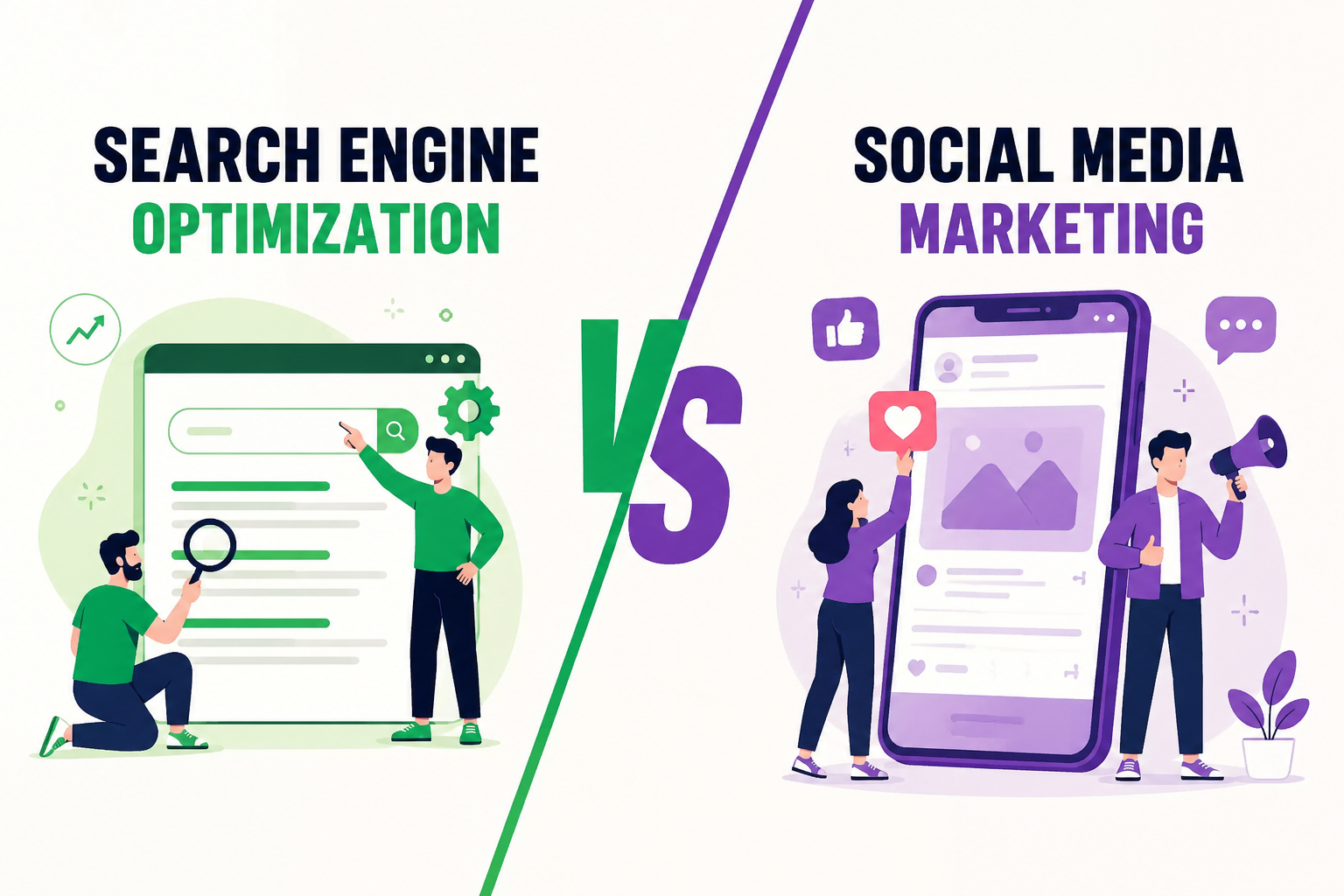
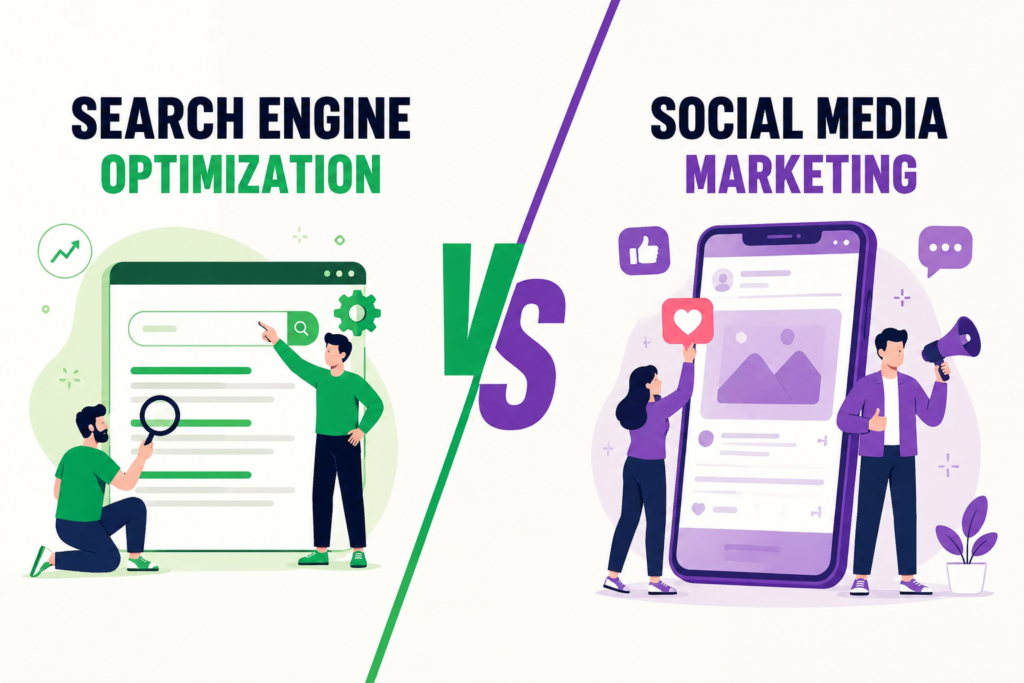
SEO and social media work together as a feedback loop. SEO content attracts organic search traffic. Social media distributes that content to new audiences who generate branded searches, backlinks, and engagement signals. Those signals feed back into SEO performance, creating a compounding cycle that grows both channels simultaneously. Think about it this way. You write a blog post targeting “how much does a kitchen remodel cost in California?” That post ranks on page two. It gets some traffic, but not much. Now you take the three most interesting numbers from that post and turn them into an Instagram carousel. The carousel gets shared. A home design blogger in Sacramento sees it, clicks through to the full post, loves the data, and links to it from her blog. That backlink bumps your post to page one. Now it gets three times the organic traffic it was getting before. More traffic means more shares, more links, more branded searches. The loop keeps going.
That is social media and seo integration in practice. It is not about choosing one over the other. It is about building each one to feed the other.
When we build campaigns for California clients, we plan the social distribution of every piece of SEO content before it is written. Not after. Which section of this blog post works as a LinkedIn post? Which stat makes a good quote graphic? Which paragraph could be a 30-second video? That thinking happens at the outline stage, and it is what turns a single piece of content into an engine that drives both organic and social growth. Our content marketing approach is built around this principle.
What Are the Main Social Media Benefits for SEO?
The five main social media benefits for seo are: increased branded search volume, earned backlinks from social discovery, faster Google indexing of new content, referral traffic that improves behavioral signals, and citations in Google AI Overviews and other AI search platforms.
1. Branded Search Volume
When people see your business on social media and later search your name on Google, that is a branded search. Google tracks branded search volume as an authority signal. We have seen California businesses increase their branded searches by 60 to 90 percent within three months of getting consistent on social. That is one of the fastest ways social media feeds back into SEO.
2. Earned Backlinks
Social media puts your content in front of journalists, bloggers, and other business owners who might link to it. A California law firm [link: /law-firm-seo/] we work with published a guide on tenant rights. After sharing it on LinkedIn, three Bay Area news outlets linked to it within two weeks. Those links moved their rankings from page three to page one for their target keyword.
3. Faster Indexing
Google discovers new content faster when it gets early social engagement. We have tested this across dozens of California client sites. Blog posts shared on social within the first hour of publishing get indexed by Google significantly faster than posts with no social distribution. For time-sensitive content, this matters.
4. Referral Traffic Signals
When social media drives visitors to your site who stay, read, and click through to other pages, Google interprets that as a quality signal. Those behavioral metrics — time on page, pages per session, bounce rate — all feed into how Google evaluates your content. Social traffic is not just traffic. It is signal.
5. AI Search Citations
This is the 2026 shift most businesses are missing. Google AI Overviews now cite Reddit discussions, LinkedIn articles, and YouTube content when generating AI answers. If your brand has a presence in those spaces, you can appear in AI search results without even ranking organically for that specific query. This changes the calculus of social media marketing and seo entirely. We wrote a full breakdown of this in our AEO vs GEO guide.
How to Combine SEO and Social Media: 6 Steps That Actually Work
To combine SEO and social media effectively, California businesses should: repurpose top SEO content for social, optimize social profiles as local citations, plan social distribution before writing content, test topics on social before committing to SEO, participate on platforms Google indexes, and track crossover metrics between both channels.
Step 1 – Repurpose Your Top SEO Content
Open Google Analytics. Find your 10 highest-traffic pages. Ask yourself: did I share this on social media more than once? Probably not. Take each page and turn it into 10 to 15 social posts spread across the next month. A single 2,000-word blog post can become LinkedIn text posts, Instagram carousels, quote cards, short-form videos, and Twitter threads. Each one links back to the original page. That is how you start the feedback loop without creating anything from scratch.
Step 2 – Turn Social Profiles into Local Citations
Your Facebook page, LinkedIn company page, Instagram bio, X profile, YouTube channel, and TikTok bio all carry business information that Google can crawl. Make sure the name, address, phone number, and website URL are identical across every platform. Write keyword-rich bios — “San Francisco SEO company” in your LinkedIn headline functions as a local citation that strengthens your Google Maps visibility. This is one of the easiest social media seo tips that most businesses completely overlook.
Step 3 – Plan Social Distribution Before Writing
This is the mindset shift that separates a real social media seo strategy from posting randomly. Before you outline a blog post, decide: what social content comes out of this? Which section works as a carousel? Which data point makes a quote card? Which paragraph becomes a video script? Planning this upfront means your content is built to work on both channels from the start. Not retrofitted as an afterthought.
Step 4 – Test Topics on Social First
Before spending eight hours writing a long-form blog post, post a short version of the idea on LinkedIn or Twitter. If it gets strong engagement, the demand is confirmed. If it gets no response, you just saved yourself a day of work on a topic nobody cares about. Social media is the cheapest focus group you will ever have. Use it before you write, not just after.
Step 5 – Show Up Where Google Is Watching
Reddit threads appear in Google search results constantly. YouTube is the second-largest search engine in the world. LinkedIn articles get indexed directly by Google. These platforms are not just social channels anymore — they are search surfaces. If your California business is absent from these conversations, you are invisible in spaces where Google actively looks for content to surface in results and AI Overviews. Participate with genuinely helpful answers, not promotional spam.
Step 6 – Track the Crossover Metrics
Stop tracking social metrics and SEO metrics in separate dashboards with no connection between them. The metrics that matter are the ones that show whether your social media and seo integration is actually working. Track branded search volume in Google Search Console after social campaigns. Monitor referral traffic from social platforms in GA4. Watch for new backlinks that originated from social discovery using Ahrefs or Semrush. If those numbers move, your strategy is working. If they do not, something needs adjusting.
Which Social Media Platform Helps SEO the Most?
LinkedIn has the strongest direct SEO impact in 2026 because its content gets indexed by Google and its audience is most likely to create backlinks. YouTube ranks second because videos appear directly in Google search results. Reddit is third due to its growing presence in Google AI Overviews. Instagram and TikTok rank lower for direct SEO value but drive significant branded search volume.
LinkedIn – Best for B2B and Professional Services
Posts and long-form articles get indexed by Google. The audience includes journalists, bloggers, and content creators who link back to sources they discover on the platform. For California law firms , financial advisors, SaaS companies, and agencies, LinkedIn should take 40 to 50 percent of your social time.
YouTube – Best for How-To and Visual Industries
Videos appear directly in Google results. Transcripts get crawled and indexed. YouTube captures search traffic that text content cannot reach. Essential for California real estate agents, healthcare providers, home services, and educators.
Reddit – Best for AI Search Visibility
Google has a direct data partnership with Reddit. Reddit threads rank in Google results for thousands of queries. Google AI Overviews cite Reddit discussions regularly. Participating in relevant subreddits with helpful, non-promotional answers is one of the fastest paths to AI search visibility for any California business.
Instagram – Best for Local Consumer Businesses
Profiles rank in Google. Geo-tagged posts reinforce local SEO signals. Product tags drive commerce. Critical for California restaurants, retail, fitness, beauty, and ecommerce brands.
TikTok – Best for Brand Awareness Under 35
Links are nofollow – no direct SEO link value. But the branded search volume TikTok generates is massive. Almost 40 percent of Gen Z searches on TikTok first. When they find your California business there and Google you later, that is SEO value TikTok gets zero credit for in standard analytics.
What Does This Look Like in Practice? A California Case Study
A real estate agency in San Diego came to us with a decent website, almost no social media presence, and flat organic traffic. We built an integrated social media seo strategy around three moves.
First, we rebuilt their content pipeline so every blog post — neighborhood guides, market reports, buyer tips — was planned with social distribution built in. Each guide included pullable stats, quotable insights, and data points designed to become standalone social posts.
Second, we optimized every social profile as a local citation with matching NAP data and keyword-rich bios across LinkedIn, Instagram, Facebook, and YouTube.
Third, we started sharing their San Diego market data and neighborhood insights on LinkedIn and Instagram three to four times per week. No generic motivational posts. Just useful, specific California real estate content.
Results after four months:
- Branded search volume: up 85%
- New backlinks from local SD publications: 12 (all earned through social discovery)
- Google Maps visibility: improved 40%
- Organic traffic: grew 67% — not from social referrals, but from the SEO signals social activity generated
That is what happens when social media marketing and seo stop operating in silos and start feeding each other. The social media did not “cause” the rankings. It triggered the behaviors — branded searches, backlinks, engagement — that Google rewarded with higher rankings. See more examples in our case studies.
5 Mistakes That Kill Your Social Media and SEO Results
The five most common mistakes are: running social and SEO with no shared plan, posting links without context or hooks, neglecting social profile consistency, using the same content format across all platforms, and quitting before results have time to compound.
Running separate strategies with separate teams and zero coordination is the biggest one. If your social media person has never seen your keyword research and your SEO person has never looked at your social analytics, you have two strategies going in different directions. Fix that before anything else.
Posting “New blog post!” with a bare link on LinkedIn is not a social media seo strategy. It is noise. Pull out the most surprising finding, the most useful data point, or the most contrarian opinion from the post. Give people a reason to stop scrolling and click. Context and hooks are what make social posts drive actual traffic.
Outdated bios, missing website links, and inconsistent business names across platforms quietly damage your local SEO without you ever noticing. If your Instagram says “SEOCALI,” your Facebook says “SEO Cali LLC,” and your LinkedIn says “SEOCali.com,” Google sees three different businesses. Audit and fix this quarterly.
What works on LinkedIn does not work on TikTok. What works on YouTube bombs on X. Take one core idea and adapt the format, length, and tone for each platform instead of copying and pasting the same text everywhere.
Finally, give the strategy time. The branded searches, the backlinks, the trust signals — they compound gradually. Three weeks of posting is not a test. Three to six months of consistent execution is. Most California businesses quit right before the results start showing up.
The Bottom Line
SEO and social media are not separate channels that happen to coexist in your marketing budget. They are two halves of the same system. Social media puts your content in front of people Google will never show it to. Those people generate the exact signals — branded searches, backlinks, traffic, engagement, AI citations — that Google uses to decide who ranks and who does not.
California businesses that figure out how to combine seo and social media into one integrated strategy will outperform the ones still running them as separate projects. That is not an opinion. It is what we see happening with our clients every month.
At SEOCALI, we build strategies where each channel feeds the other. Our SEO work drives organic visibility. Our social media marketing amplifies content and generates brand signals that speed up rankings. Our content marketing creates the material both channels depend on. Everything connects.
If you want to know where your California business stands right now and what an integrated strategy would look like for your specific market, grab our free 47-point SEO audit. We break it all down in 48 hours. No pitch. No pressure. Just a clear picture of what is working and what is not.
Frequently Asked Questions
Q1: How do SEO and social media work together?
SEO and social media work together as a feedback loop. SEO content ranks on Google and drives organic traffic. Social media distributes that content to audiences who generate branded searches, backlinks, referral traffic, and engagement signals — all of which feed back into stronger SEO performance. Neither channel reaches its full potential without the other, especially in competitive California markets where every ranking advantage matters.
Q2: Does social media directly affect Google rankings?
No. Google has confirmed that social engagement metrics are not direct ranking factors. But social media creates powerful indirect effects — increased branded search volume, earned backlinks, faster content indexing, stronger referral traffic signals, and now citations in Google AI Overviews — that Google’s algorithm rewards. For California businesses, these indirect signals often make the difference between page one and page two.
Q3: Which social media platform is best for SEO in 2026?
LinkedIn has the strongest direct SEO impact because its content gets indexed by Google and its audience is most likely to create backlinks. YouTube ranks second because videos appear directly in Google search results. Reddit is increasingly important because Google AI Overviews frequently cite Reddit discussions. Instagram and TikTok are most valuable for local California businesses because of geo-tagging and branded search volume generation.
Q4: How long does it take for social media to affect SEO?
Faster content indexing can happen within days of social sharing. Branded search volume improvements typically appear within one to two months of consistent posting. Earned backlinks from social discovery build over three to six months. The key is consistency — sporadic posting produces sporadic results. Give the strategy at least 90 days before evaluating whether the crossover metrics are moving.
Q5: Should I invest in SEO or social media first?
Start with SEO. Your website needs a solid technical foundation, optimized content, and proper structure before social media can amplify it. Without that, social traffic has nowhere productive to go. Once your SEO fundamentals are in place, adding social media multiplies the return on everything you have already built. The strongest approach is running both with a shared strategy from the start.
Q6: What is the easiest way for a small California business to start combining SEO and social media?
Start by repurposing your best-performing SEO content into social media posts. Optimize every social profile with consistent business name, address, phone number, and website URL. Post three to four times per week on your strongest platform. Engage with your local California community. Track branded search volume and referral traffic to measure impact. That baseline effort is enough to start the feedback loop — and most of your local competitors are not even doing this much.
Q7: Can social media content appear in Google AI Overviews?
Yes. Google AI Overviews now cite Reddit threads, LinkedIn articles, YouTube video transcripts, and even TikTok-related content when generating AI answers. Social media content is no longer just an indirect SEO signal — it is becoming a direct source material for AI search results. California businesses that participate in these platforms with helpful, expert content have a new path to search visibility that did not exist before 2025.