
THE 30-SECOND VERSION
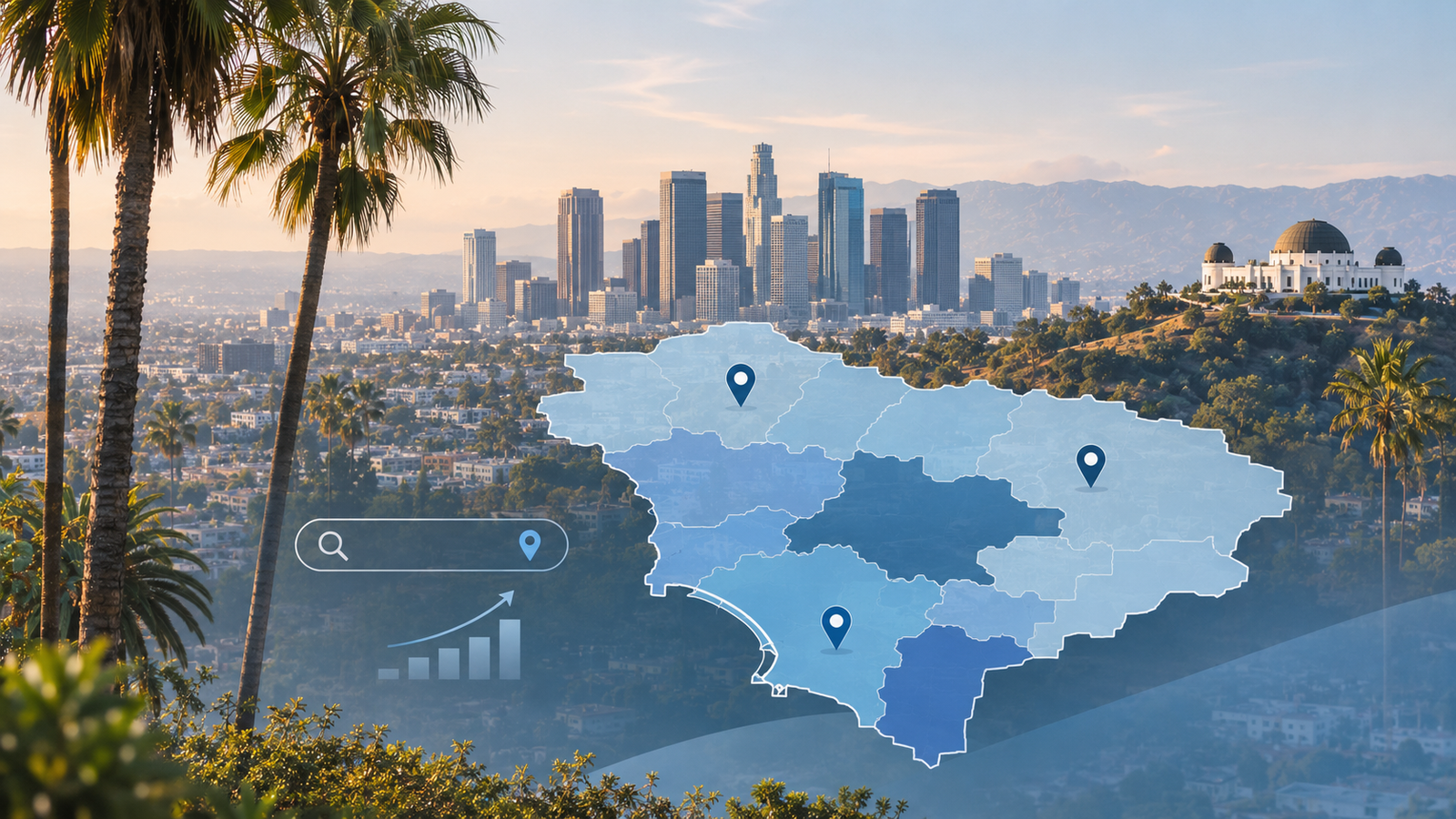
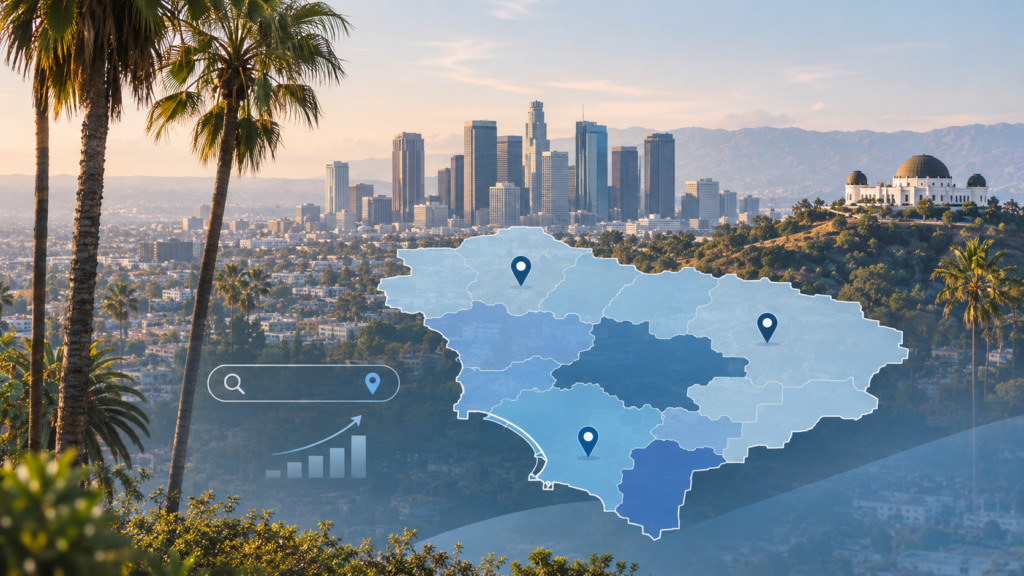
- Local SEO in Los Angeles is not one market. LA County holds 88 incorporated cities and roughly 140 unincorporated areas, so the business that ranks in Pasadena is usually invisible in Santa Monica.
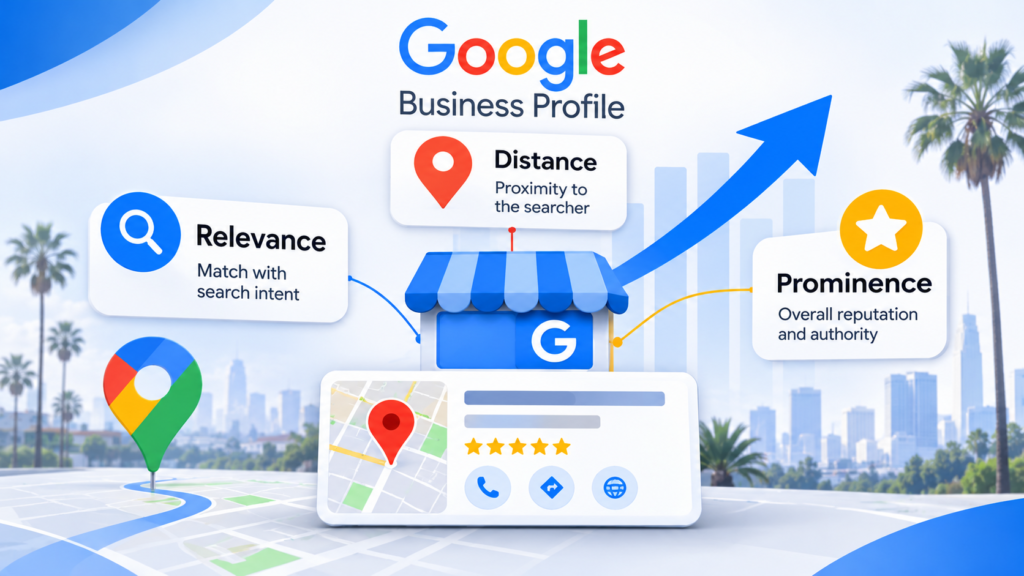
- Google ranks local results on three things it names openly: relevance, distance, and prominence. Distance is the one you cannot buy your way around, which is why neighborhood targeting beats citywide targeting.
- Your Google Business Profile type (storefront, hybrid, or service area) sets the ceiling on your reach. Google caps service areas at 20 and expects the outer boundary to stay within about two hours of driving time.
- The competitive crunch sits in four categories: legal, dental, real estate, and eCommerce. Each needs a different mix of proximity, reviews, and content depth.
- Start with three to five neighborhoods where you already have customers. Expand only when each page earns its own leads.
Running a business in Los Angeles means competing in a city that behaves like forty cities stacked on top of each other. Local SEO in Los Angeles fails most often not because the tactics are wrong, but because they get aimed at “Los Angeles” instead of at the six square miles where your customers live.
We have run California-only campaigns since 2011, and the pattern repeats. A business pours budget into one page targeting the whole metro, ranks nowhere, and concludes that local search does not work here.
Here is our flat opinion: for most LA businesses, a citywide page is the wrong first move. Build the neighborhood layer first, then let the citywide page inherit the authority those pages generate.
Why local SEO in Los Angeles is really 88 markets, not one city
Los Angeles County contains 88 incorporated cities and approximately 140 unincorporated areas,according to the county’s own geography office. Each has its own search behavior, competitor set, and often its own language mix.
Think of it like radio coverage. A transmitter in Burbank reaches the Valley clearly and fades to static by Manhattan Beach. Google’s local algorithm behaves the same way, and no amount of on-page work extends the signal past its physical range.
The scale underneath this matters. Census Bureau estimates put Los Angeles County at 9,694,934 residents as of July 1, 2025, with 304,988 employer establishments and 1,128,124 nonemployer establishments in 2023.
That is roughly 1.4 million businesses inside one county, most of them chasing the same handful of citywide head terms.
Language is the second fracture line. The same Census Bureau data shows 55.1% of LA County residents aged five and over speak a language other than English at home, measured across 2020 to 2024.
In Glendale, Koreatown, and Boyle Heights, that figure reshapes which queries exist at all. A business optimizing only in English is competing for a fraction of its real market.
Then there is drive time. The mean commute in LA County runs 30.4 minutes, which makes a five-mile radius a meaningless unit here. Willingness to travel, not raw distance, defines your real service area.
How Google decides who shows up in the LA map pack
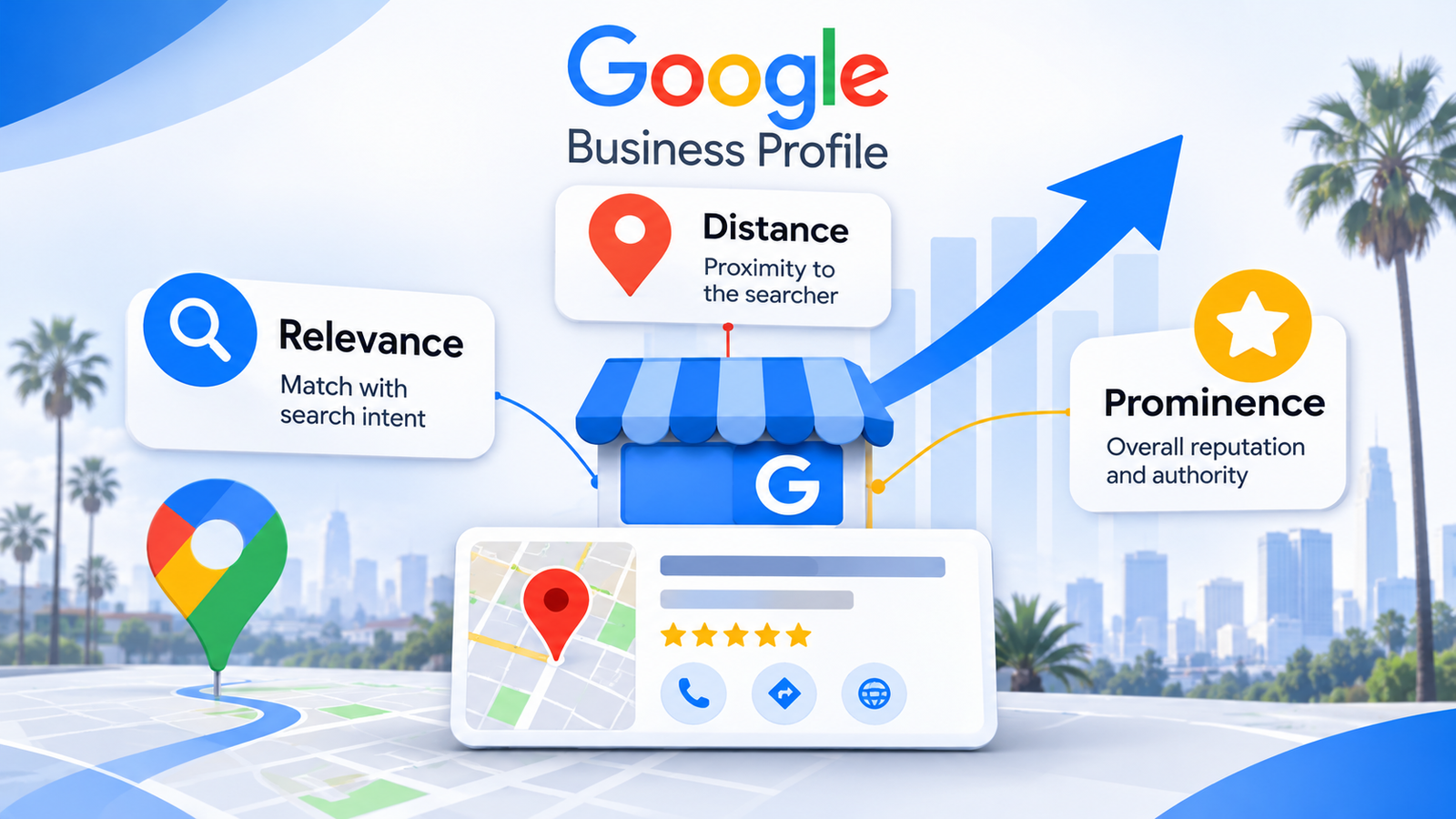
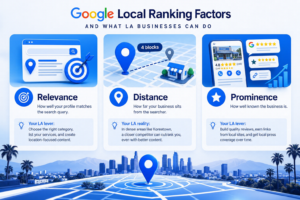
Google states plainly that local results are mainly based on relevance, distance, and prominence, and that there is no way to request or pay for better placement in Google Maps.
Those three factors behave very differently in a city this spread out.
Relevance is how well your profile matches the query. You control this one most directly, through category selection, services listed, and the content on the page your profile points to.
Distance is how far your business sits from the searcher. In a dense market like Koreatown, a competitor four blocks away can outrank you on proximity alone, regardless of how good your site is.
Prominence is how well known the business is. Google names links from other websites plus review count and rating as inputs, which is why review velocity and local press coverage compound over time.
The practical translation for LA: relevance gets you considered, distance decides who sees you, and prominence breaks the tie among everyone who clears the first two.
That ordering explains the most common failure in LA local search. A business with excellent content and strong reviews still loses the Santa Monica map pack if it operates out of Van Nuys, because distance was never negotiable.
The workaround is not to fake proximity. It is to build genuine relevance for each area you serve: a real page, real local proof, and reviews that name the neighborhood.
Which LA neighborhood should you target first?
Pick the three to five areas where you already close business. Expanding into a neighborhood you have never served produces a thin page, and Google’s spam policies name city-targeted pages built mainly to manipulate rankings as doorway pages.
The six markets below cover most of the demand we see from LA clients. Each rewards a different angle.
Santa Monica
Santa Monica blends a permanent resident base with heavy tourist and business traffic. The commercial corridors along Wilshire and Montana carry some of the highest competition per square mile in the county.
Winning here usually comes down to reviews and photos rather than content volume. Searchers are comparing three profiles on a phone while standing on the street.
Pasadena
Pasadena behaves like a self-contained city rather than an LA neighborhood, which works in your favor. Residents search “in Pasadena” far more often than “in Los Angeles,” so the modifier is explicit and the intent is clean.
Professional services dominate: legal, healthcare, education, home services. A dedicated Pasadena page with local case detail outperforms a county-wide page almost every time.
Glendale
Glendale is where multilingual search stops being optional. The city has one of the largest Armenian communities in the United States, and query volume splits across languages in legal, medical, auto, and family services.
If your staff speaks the language, say so on the page and in your profile description. That single signal moves conversion rate more than most technical fixes.
Burbank
Burbank runs on media and production. Searches skew toward vendors, studios, equipment, and the service businesses supporting a workforce with unusual hours.
Extended hours and fast response times are real differentiators here, and both belong on the profile rather than buried in a site footer.
Calabasas
Calabasas is the clearest underserved opportunity in the county right now. Demand for a Calabasas SEO company sits close to citywide expert-level volume, while the competition behind those terms is a fraction as strong.
The same pattern holds across most Calabasas service categories: affluent households, high transaction values, and far fewer businesses fighting for the map pack than ten miles east. If you serve the 101 corridor, a dedicated page pays back fastest here.
Beverly Hills
Beverly Hills is the opposite case: maximum competition, maximum transaction value. Aesthetics, legal, real estate, and luxury retail are saturated, and prominence does most of the ranking work.
Do not enter Beverly Hills as your first neighborhood unless you already have review volume and authority. Build somewhere winnable, then move in.
| Neighborhood | Competition | Best fit | First priority |
| Santa Monica | High | Hospitality, wellness, legal, retail | Reviews and photo freshness |
| Pasadena | Medium | Legal, healthcare, home services | Dedicated city page |
| Glendale | Medium | Medical, legal, auto, family services | Multilingual signals |
| Burbank | Medium | Production, media vendors, services | Hours and response time |
| Calabasas | Low | Professional and home services | Page plus local citations |
| Beverly Hills | Very high | Aesthetics, legal, real estate | Review velocity and authority |
Storefront or service area? The profile choice that sets your LA radius
Your Google Business Profile falls into one of three types, and the choice is not cosmetic. It determines whether your address shows publicly and how far your visibility can extend.
A storefront serves customers at a fixed location with permanent on-site signage and displays its address. A service-area business travels to customers and hides its address. A hybrid does both: it shows the address, sets staffed hours, and also designates a service area.
Google is specific about the dividing line.
A business without permanent on-site signage is not eligible as a storefront and should be listed as a service-area business.
That pulls most home-based LA operators into the service area category whether they like it or not. It also means your Google Maps pin disappears, replaced by a shaded region.
The rules carry three limits worth knowing before you set yours:
- Twenty areas maximum. You can set up to 20 service areas by city, postal code, or similar boundary.
- About two hours of driving time. Google says the overall boundary should not exceed roughly two hours of drive time from your base. In LA traffic, that is a much smaller map than it sounds.
- No radius option. You cannot define a service area as a distance radius, and profiles set up that way historically cannot be edited back.
One more constraint catches people out. If you run a service area business, Google gives you a single profile for the entire territory you cover. You cannot open a second profile for Pasadena and a third for Burbank.
That is exactly why neighborhood pages on your own website matter so much for LA service businesses. The profile is capped at one, but your site has no such limit.
Adding all 20 slots does not make you rank in 20 places either. Distance still applies, so a Culver City plumber listing Pomona gains nothing from it.
Which LA industries are hardest to rank in?
Four categories absorb most of the competitive pressure in Los Angeles, and each fails for a different reason.
Legal. Downtown and Century City host the densest legal results in the county. Prominence dominates, meaning review count, citation quality, and genuine authority decide placement. Personal injury and immigration are effectively unwinnable on a thin page.
Dental. Proximity rules here more than anywhere else. Patients filter by distance first, which makes a tight neighborhood strategy with strong review velocity far more effective than a broad citywide push.
Real estate. Agent results fragment by neighborhood almost perfectly, which is good news. One agent can realistically own eight or nine adjacent neighborhoods in a way they could never own “Los Angeles.”
eCommerce. Online stores compete nationally for product terms but still benefit from local signals on brand and pickup queries. For LA direct-to-consumer brands, the win usually comes from product and category depth rather than map pack placement.
The pattern across all four: the more proximity-sensitive the category, the smaller your target area should be.
What neighborhood-level wins actually look like
Two LA campaigns from our own portfolio show the gap between a citywide approach and a neighborhood one. Both results are pulled from Google Analytics and Search Console.
West LA real estate agent: +280% qualified leads in 7 months. Rather than chasing one competitive citywide term, we built dedicated neighborhood coverage. The agent reached the top position across nine neighborhoods including West LA and Santa Monica.
Nine neighborhood pages ranking first is a fundamentally different asset than one citywide page ranking fourth. The long tail compounds, and each page can be defended independently.
Los Angeles eCommerce brand: +318% organic revenue in 9 months. A Shopify apparel brand grew organic revenue 318% across nine months at 3.8x ROI. That campaign leaned on product and category depth rather than map pack work, which is the right call for a store with no walk-in traffic.
The contrast is the lesson. The real estate campaign needed geography. The eCommerce campaign needed catalog structure. Running either playbook on the wrong business wastes months.
Full breakdowns are in our case study portfolio, and our eCommerce SEO work covers the Shopify side in more detail.
What a Los Angeles SEO audit should check that a generic one misses
A standard technical crawl catches broken links and slow pages. A Los Angeles SEO audit has to go further, because the failures in this market are geographic rather than technical.
Six LA-specific checks we run that generic audits skip:
- Grid-based rank tracking, not single-point. Your ranking at your office address tells you almost nothing. Scanning across a geographic grid shows where visibility actually drops off.
- Profile type correctness. We verify the storefront, hybrid, or service-area setting matches how the business operates, since a wrong setting caps reach permanently.
- Neighborhood page differentiation. Pages that swap the city name and keep the body text identical read as doorway pages to Google. We check for real differentiation, not templated spin.
- Language-market fit. In Glendale, Koreatown, and East LA, we check whether meaningful demand exists in a second language and whether the page and title language match.
- Citation relevance over volume. Local citations from a neighborhood chamber directory carry more weight here than fifty generic directory submissions.
- LocalBusiness schema accuracy. We confirm the markup matches the live profile, since a mismatch between your schema address and your Google Business Profile sends conflicting signals.
For the technical layer, our 47-point audit checklist walks through every check with free tools, and our SEO audit service covers what needs manual review.
One honest caveat: an audit tells you what is broken, not how long the fix takes. In competitive LA categories, meaningful map pack movement typically takes three to six months even after everything is corrected.
When to bring in an SEO expert in Los Angeles
Most of what we have described is doable in-house. A single-location business serving two or three neighborhoods can run its own profile, request reviews, and publish decent local pages.
Bringing in help makes sense at a specific threshold: more than four neighborhoods, more than one language, or a category where competitors have a multi-year head start. A good SEO expert Los Angeles businesses actually keep will tell you when you are below that line.
What an LA-specific partner adds over a national agency is narrower than the marketing usually claims. It comes down to three things:
- Neighborhood-level keyword data rather than metro-level estimates, which hide where the winnable volume sits.
- Local citation and link relationships with chambers, business journals, and neighborhood publications that cannot be bought quickly.
- Geo-segmented reporting so you can see which micro-markets produce revenue and which drain content budget.
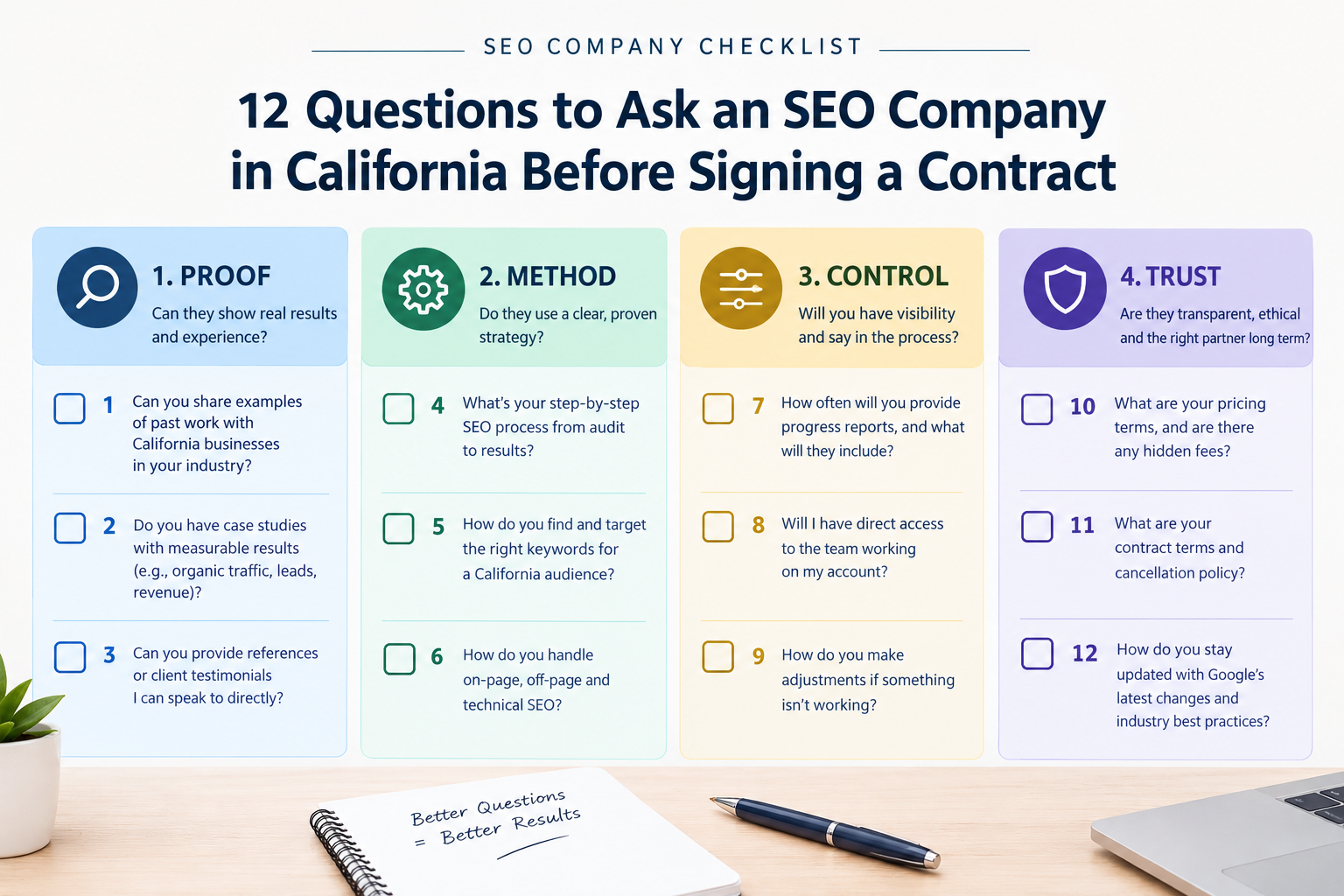
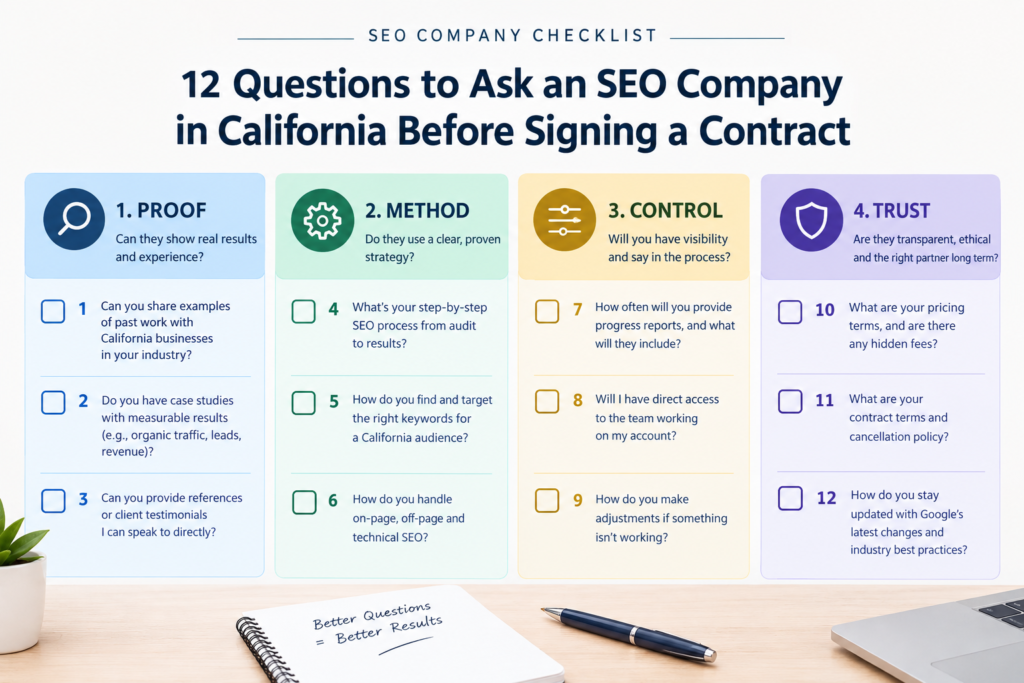
If you are evaluating providers, our guide to choosing an SEO company in California lists the twelve questions worth asking before signing.
For LA-specific engagements, our Los Angeles SEO services page covers how we structure campaigns. South Bay businesses should also see our Long Beach SEO coverage, since Long Beach operates as its own market rather than an extension of the LA basin.
Frequently asked questions
Should you target Los Angeles or specific neighborhoods?
Target neighborhoods first for most businesses. A citywide page competes against the strongest brands in a 9.7 million person county, while a neighborhood page competes against a handful of local operators. Build three to five pages where you already have customers, then let the citywide page absorb the authority they build.
How long does local SEO take in Los Angeles?
Profile improvements such as category corrections, hours, and photos can show movement within a few weeks. Competitive neighborhood rankings typically take three to six months, and saturated categories like Beverly Hills aesthetics can take longer. Review velocity and local link acquisition are the two factors that most reliably shorten the timeline.
Can you create a separate Google Business Profile for each LA neighborhood?
Not if you are a service-area business. Google allows one profile for the entire area such a business serves. Storefronts get one profile per staffed location with permanent signage. Creating extra profiles for neighborhoods you do not physically occupy risks suspension, which is why neighborhood pages on your own website are the correct mechanism.
How many service areas should a Los Angeles business list?
Fewer than the maximum. Google permits up to 20, but listing areas you cannot realistically serve dilutes relevance without gaining distance. Most LA service businesses do better with five to eight areas inside a realistic drive. Keep the overall boundary inside about two hours of driving time, as Google recommends.
Does the local SEO Los Angeles playbook work for an eCommerce store with no storefront?
Partly. An online-only store cannot rank in the map pack without a physical location, so the opportunity sits in organic product and category rankings plus brand searches. If you offer local pickup or run a showroom, a service-area or storefront profile becomes worthwhile. Otherwise, catalog depth drives more revenue than local signals.
Do you need to add “near me” to a page to rank for near me searches?
No. Google resolves near me searches using proximity, profile accuracy, reviews, and relevance rather than the literal phrase. Stuffing “near me” into titles and headings reads badly and adds nothing. Accurate location data, a complete profile, LocalBusiness schema that matches it, and steady reviews do the work instead.
How much does local SEO cost in Los Angeles?
Pricing varies widely by category competitiveness and neighborhood count, so treat any flat advertised number with suspicion. What matters more than the monthly figure is coverage: how many neighborhoods, whether content is included, and whether reporting is segmented by area. Ask providers to tie the quote to a specific target list.