
THE 30-SECOND VERSION
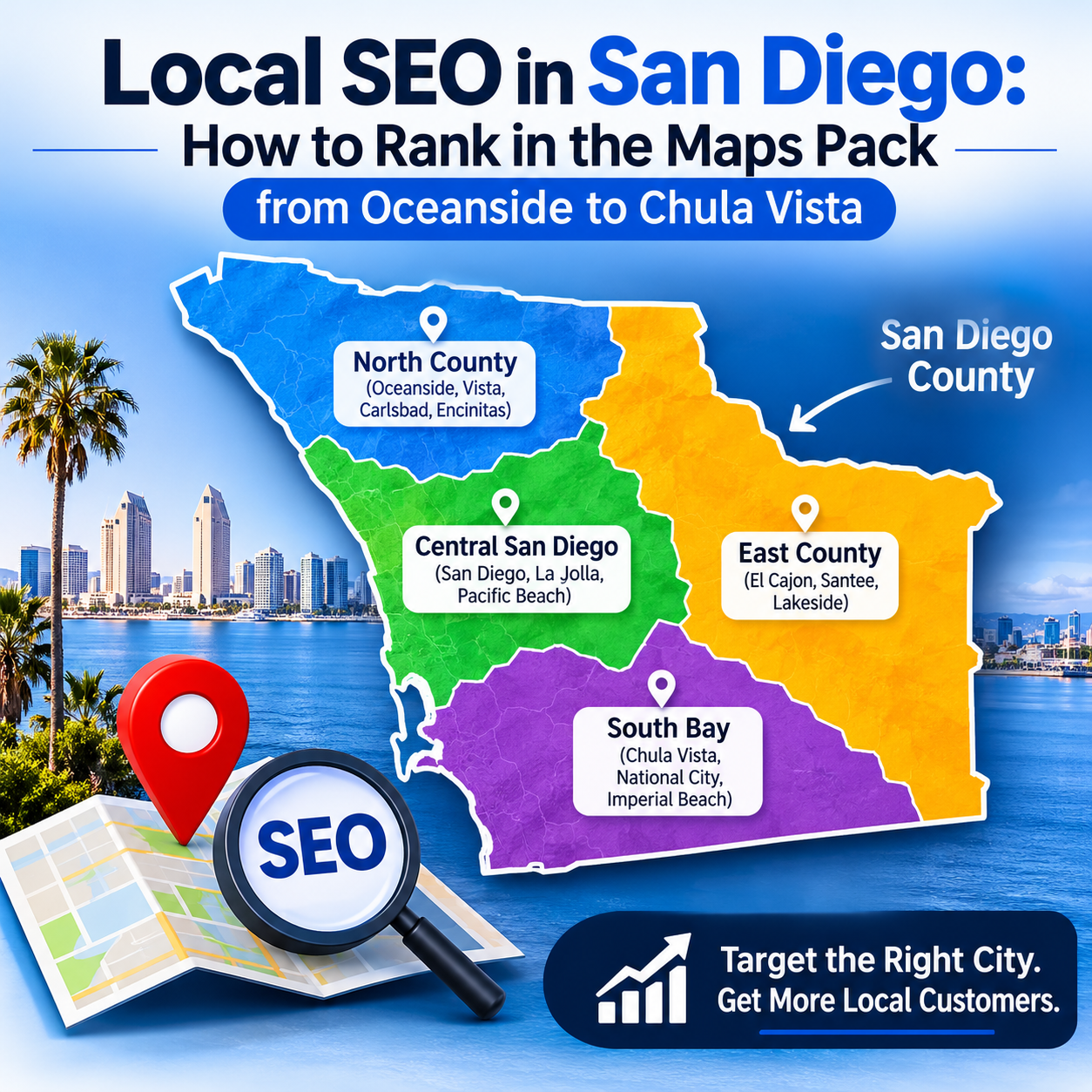
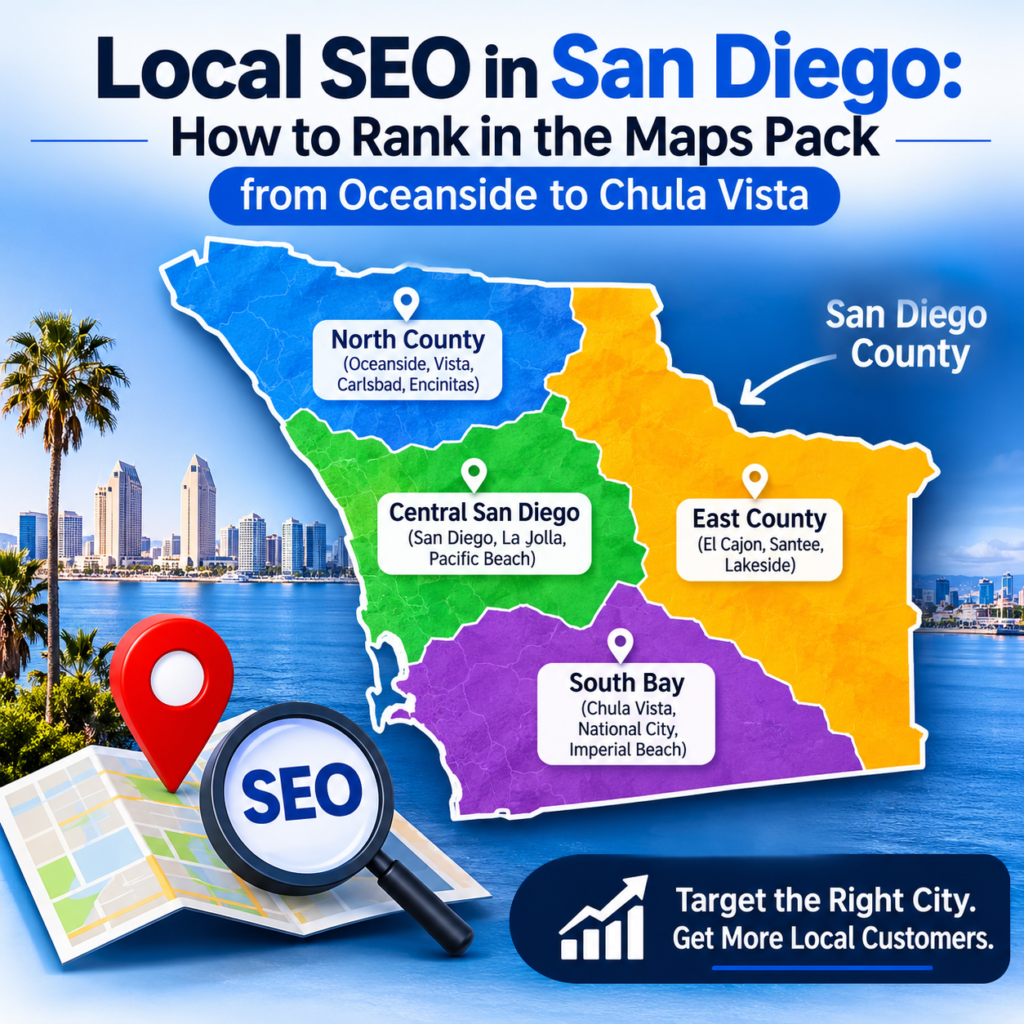
- San Diego is not one local search market. The county holds 18 incorporated cities plus a large unincorporated area, so the business winning the map pack in Oceanside is usually invisible in Chula Vista.
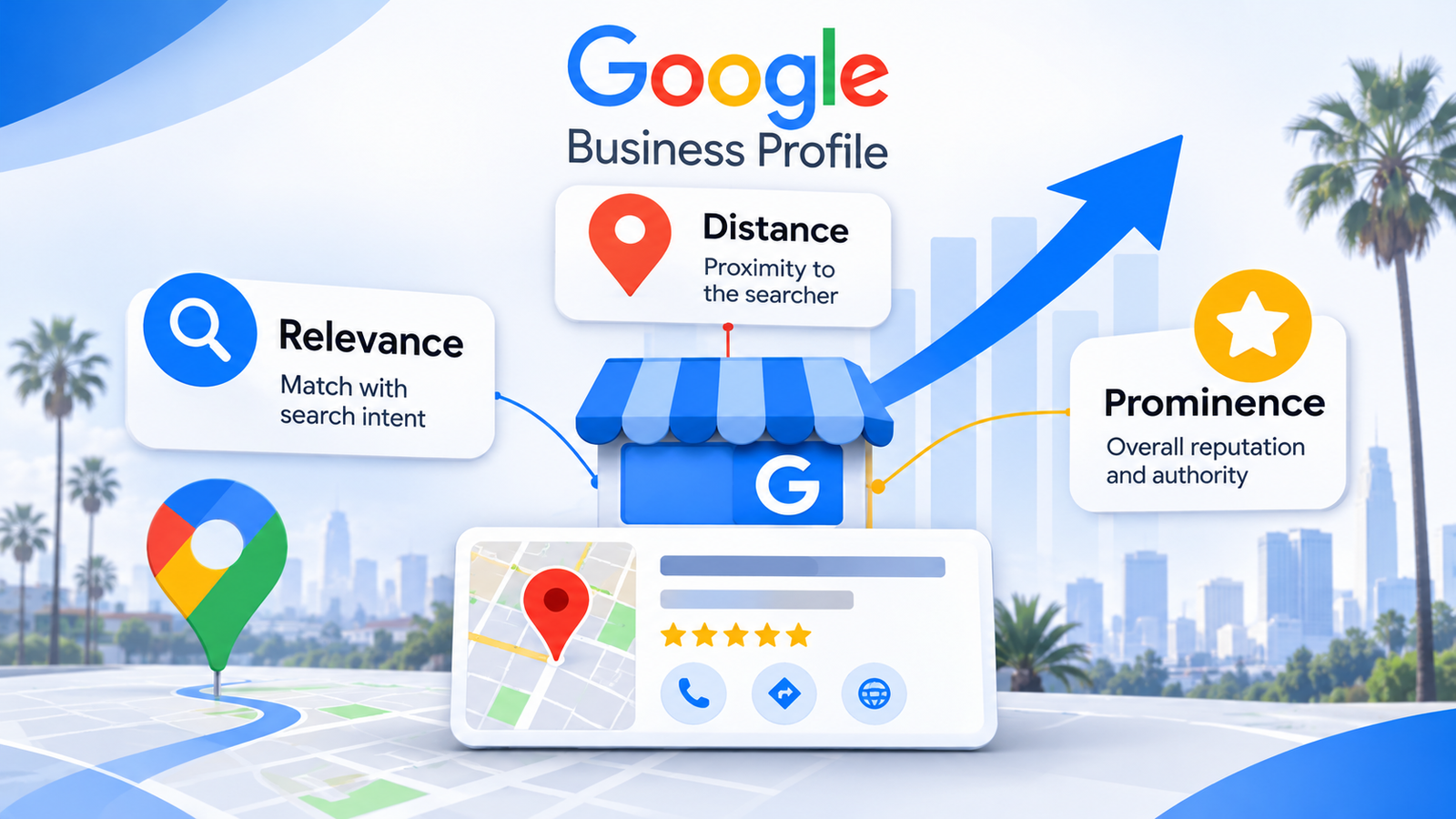
- Google ranks local results on relevance, distance and prominence. Distance is the one you cannot buy around, which is why a city-level page beats a county-level page almost every time.
- The 2026 expert data puts your primary Google Business Profile category at the top of the list, just ahead of proximity. Category is free to fix. Proximity is not.
- South Bay is a bilingual, binational market. Chula Vista is 61.1% Hispanic or Latino, and 57.4% of residents speak a language other than English at home, so English-only pages concede half the demand.
- Pick three to five cities where you already have customers. Give each one its own page. Expand only when a page earns its own leads.
Running a local business here means competing in a county that behaves like a dozen separate regions with a national border attached to the bottom of it.
Local SEO San Diego campaigns fail most often not because the tactics are wrong, but because they get pointed at “San Diego” when the customer is searching in Vista, Encinitas or Eastlake.
We have run California-only campaigns since 2011, and the San Diego pattern is consistent. A business builds one page for the whole county, ranks nowhere in particular, and concludes that local search is saturated.
Here is our flat opinion: for almost every San Diego business, the county-wide page is the wrong first move. Build the city layer first and let the county page inherit the authority those pages generate.
Why San Diego local SEO is really 18 markets and a border
San Diego County contains 18 incorporated cities plus a large unincorporated area, each with its own search behavior, competitor set and often its own language mix.
Think of it like a chain of radio transmitters rather than one broadcast tower. A signal strong in Carlsbad fades to static by the time it reaches Imperial Beach, and no amount of on-page work extends its physical range.
The numbers underneath this explain the competition. Census Bureau data records 93,407 employer establishments and 299,736 nonemployer establishments in San Diego County in 2023.
That is close to 400,000 businesses inside one county, and a large share of them are chasing the same handful of county-wide head terms.
Scale fractures the market further. San Diego city alone holds an estimated 1,406,106 residents as of July 1, 2025, while Chula Vista holds 275,533 and Oceanside 170,483.
Those are three genuinely different cities, not three neighborhoods. Treating them as interchangeable is the single most expensive assumption in San Diego local search.
How Google decides who shows up in the San Diego map pack
The Google Maps pack (also called the local pack or the Maps 3-pack) is the block of three business listings with a map that sits above the standard organic results. It is what a “near me” search returns before anything else.
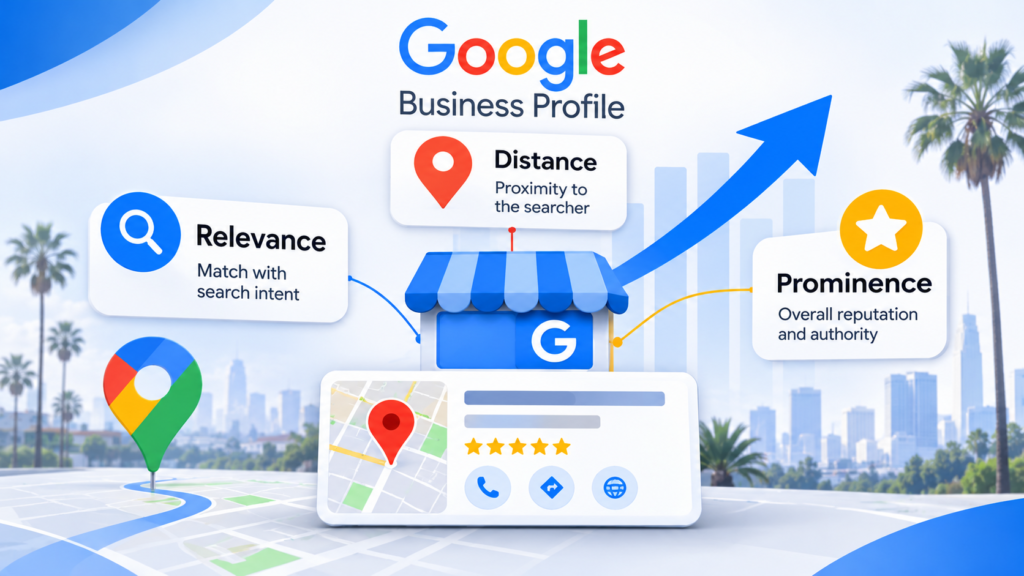
Google states plainly that local results are mainly based on relevance, distance and prominence, and that there is no way to request or pay for better local placement.
Relevance is how closely your profile matches the query. You control this through category selection, the services you list, and the content on the page your profile points to.
Consistent NAP data (your name, address and phone number, written identically everywhere) is what ties those signals to one business rather than three half-matching records.
Distance is how far your business sits from the searcher. A competitor six blocks closer can outrank you on proximity alone, whatever your site looks like.
Prominence is how well known the business is. Google names links from other sites plus review count and rating as inputs, which is why review velocity compounds over months rather than weeks.
The practical translation for this county: relevance gets you considered, distance decides who sees you, and prominence breaks the tie among everyone who clears the first two.
That ordering explains the most common failure here. A Carmel Valley business with excellent content and strong reviews still loses the National City map pack, because distance was never negotiable.
We cover the profile-level mechanics in depth in our guide to Google Business Profile optimization for California businesses, so this article stays on the geography problem instead.

What the 2026 ranking data says to fix first
The map pack ranking factors most San Diego businesses optimize for are not the ones that moved in 2026.
Whitespark’s 2026 Local Search Ranking Factors report, published November 6, 2025, asked 47 local search practitioners to score 187 factors. The top of the local pack list is worth reading closely, because two of the top five are free to fix and two are effectively fixed by your lease.
| Rank | Factor | Score | Can you change it? |
| 1 | Primary Google Business Profile category | 227 | Yes, in minutes |
| 2 | Proximity of address to the searcher | 225 | No, short of moving |
| 3 | Keywords in the profile business title | 223 | Only if they are your real name |
| 4 | Physical address in the city of search | 213 | No, short of moving |
| 5 | Business is open at the time of search | 189 | Yes, through accurate hours |
Two findings from that report matter more than the rest for a San Diego operator.
Being open is now a top-five factor. Your listing can sit at the top during business hours and slide once you close. For a Pacific Beach restaurant or a North County emergency plumber, posted hours are a ranking decision rather than an admin detail.
Review recency climbed hard. Recency of reviews now ranks 11th for the local pack, well above where it sat in earlier editions. A profile with 200 reviews and nothing new in eight months is weaker than a profile with 60 reviews arriving steadily.
One honest caveat about this data: it is expert opinion, not leaked algorithm documentation. The report says so itself. Treat the ordering as a strong prior, not as gospel, and verify against your own geo-grid tracking.
Which San Diego sub-market should you target first?
Pick the three to five cities where you already close business. Expanding into an area you have never served produces a thin page, and Google’s spam policies name city-targeted pages built mainly to manipulate rankings as doorway pages.
The five sub-markets below cover most of the demand we see from San Diego clients. Each rewards a different angle.
Downtown, Gaslamp and central San Diego
The densest competition per square mile in the county, with hospitality, legal and professional services stacked into a few ZIP codes.
Proximity does most of the work here, which means content volume rarely rescues a business sitting outside the core. Reviews and photo freshness decide the tie.
La Jolla and the coastal corridor
High transaction values, high competition, and a searcher base that compares three profiles before calling anyone.
Aesthetics, dental, legal and real estate dominate. This is not where to start unless you already have review volume, because prominence carries more weight than anywhere else in the county.
North County coastal: Oceanside and Carlsbad
This is the clearest underserved opportunity in the county right now, and it is where local SEO services in Oceanside tend to pay back fastest.
Oceanside runs three economies at once: a beach town, a military community anchored by Camp Pendleton, and a growing maker and trades base. Carlsbad sits next door with a very different buyer.
Census estimates put Oceanside at 170,483 residents as of July 1, 2025, with the city down 2.1% since the 2020 count. Population is flat, but commercial development along the 78 corridor is not.
The competitive set here is thinner than central San Diego, so a genuinely local page plus chamber-level citations moves the needle faster than the same effort would downtown.
Chula Vista and the South Bay
The second-largest city in the county and the most consistently misunderstood market in it. We have given this its own section below, because the usual playbook does not apply.
East County: El Cajon, Santee and La Mesa
Lower competition, tighter communities, and a strong preference for businesses that read as genuinely local rather than as a downtown firm with a service radius.
Local area code numbers, real community sponsorships and reviews that name the city carry unusual weight here.
| Sub-market | Competition | Best fit | First priority |
| Downtown and Gaslamp | Very high | Hospitality, legal, professional services | Reviews and photo freshness |
| La Jolla and coastal | Very high | Aesthetics, dental, real estate | Review velocity and authority |
| Oceanside and Carlsbad | Low to medium | Trades, home services, retail | Dedicated city page plus citations |
| Chula Vista and South Bay | Medium | Healthcare, cross-border B2B, consumer services | Bilingual page and profile |
| East County | Low | Home services, auto, family services | Local signals and community links |

Why an SEO company in Chula Vista needs a different playbook
Chula Vista is where the generic San Diego strategy breaks down completely, and the reason is demographic rather than technical.
Census Bureau data puts Chula Vista at 61.1% Hispanic or Latino.
It also records 57.4% of residents aged five and over speaking a language other than English at home, measured across 2020 to 2024.
For San Diego city, the comparable figure is 39.0%.
That gap changes which queries exist at all. A business publishing only in English in Chula Vista is competing for roughly half of its real market while the other half goes unserved.
Then there is the border, a few miles south.
The San Ysidro port of entry is the busiest land crossing in the Western Hemisphere, and Otay Mesa is the busiest heavy-duty truck crossing in California.
Daily volume through San Ysidro puts a steady commuting population on both sides of that line.
Picture a dental practice on Third Avenue. Its catchment is not a radius drawn around the office. It includes commuters who sleep in Tijuana, work in San Diego, and search in whichever language they are thinking in that morning.
A good SEO company Chula Vista businesses stay with will say which half of the market you are currently missing. Three things follow from that:
- A genuine Spanish content track, not a translation plugin. Separate URLs with correct hreflang, written for how people actually search, not run through machine translation.
- A profile description and services listed in both languages. Your Google Business Profile is the first thing a Spanish-dominant searcher reads, and it is usually the last English-only asset anyone thinks to fix.
- Reviews in both languages. Review text is itself a relevance signal, and Spanish-language reviews tell Google who this business actually serves.
This is exactly why South Bay businesses should start from our Chula Vista SEO services page rather than the county-level one. The two markets need different work, and pointing both at a single page costs rankings in each.
How tourism and seasonality reshape the San Diego calendar
San Diego’s visitor economy creates a demand curve that most national SEO playbooks ignore entirely.
Summer brings a searcher who has no local knowledge, no preferred provider and a phone in hand. Winter brings a resident base that already knows the options. Those are two different audiences hitting the same keywords.
For hospitality, retail, rentals and anything near the coast, the practical implication is timing. Content and profile work for the summer peak needs to be live by spring, because map pack movement usually takes months rather than weeks.
Three seasonal adjustments worth making:
- Publish seasonal pages early. A page targeting summer demand that goes live in June has missed the window it was built for.
- Widen hours in peak season and update the profile. Since being open at search time is a top-five factor, unposted extended hours are lost rankings.
- Push review requests during the busy months. Volume is highest when foot traffic is highest, and recency carries that momentum into the quiet season.
Military rotation at Camp Pendleton adds a second, separate cycle in North County that has nothing to do with tourism. Businesses serving that base see demand move on orders, not on weather.
What affordable SEO services San Diego businesses can actually buy
Pricing in this market runs wide enough to be meaningless without context, so treat any flat advertised number with suspicion.
Our own plans run $900, $1,600 and $3,000 a month, all month to month with no lock-in. What matters more than the monthly figure is what the budget covers geographically.
Here is the honest trade-off at the entry level. A smaller budget buys depth in one city, not coverage across five. Spreading $900 across Oceanside, Chula Vista and El Cajon produces three thin pages and no map pack placement in any of them.
A realistic sequence for a budget-conscious San Diego business:
- Months 1 to 2: fix the profile. Primary category, accurate hours, complete services, real photos. This is the highest-return work available and it costs nothing but attention.
- Months 2 to 4: build one strong city page. The city where you already have the most customers, with real local detail rather than a swapped city name.
- Months 3 onward: run reviews as a system. Steady requests, every month, with responses. Recency is doing more work now than it used to.
- Months 4 to 6: clean up citations. Matching NAP details across the sites that matter, which is a shorter list than most vendors suggest.
- Month 6 onward: add the second city. Only once the first page is producing leads on its own.
Our 47-point audit checklist walks through the technical layer with free tools if you would rather run the first pass yourself.
When to hire a local SEO marketing company in San Diego
Most of what we have described is doable in-house. A single-location business serving two or three cities can run its own profile, request reviews and publish decent local pages.
Bringing in help makes sense at a specific threshold: more than four cities, more than one language, or a category where competitors have a multi-year head start. A local SEO marketing company San Diego owners actually keep will tell you when you are below that line.
What a San Diego-specific partner adds over a national agency is narrower than the marketing usually claims. It comes down to three things:
- City-level keyword data rather than metro-level estimates, which hide where the winnable volume actually sits.
- Local citation and link relationships with chambers, business journals and community publications that cannot be bought quickly.
- Geo-segmented reporting so you can see which cities produce revenue and which drain content budget.
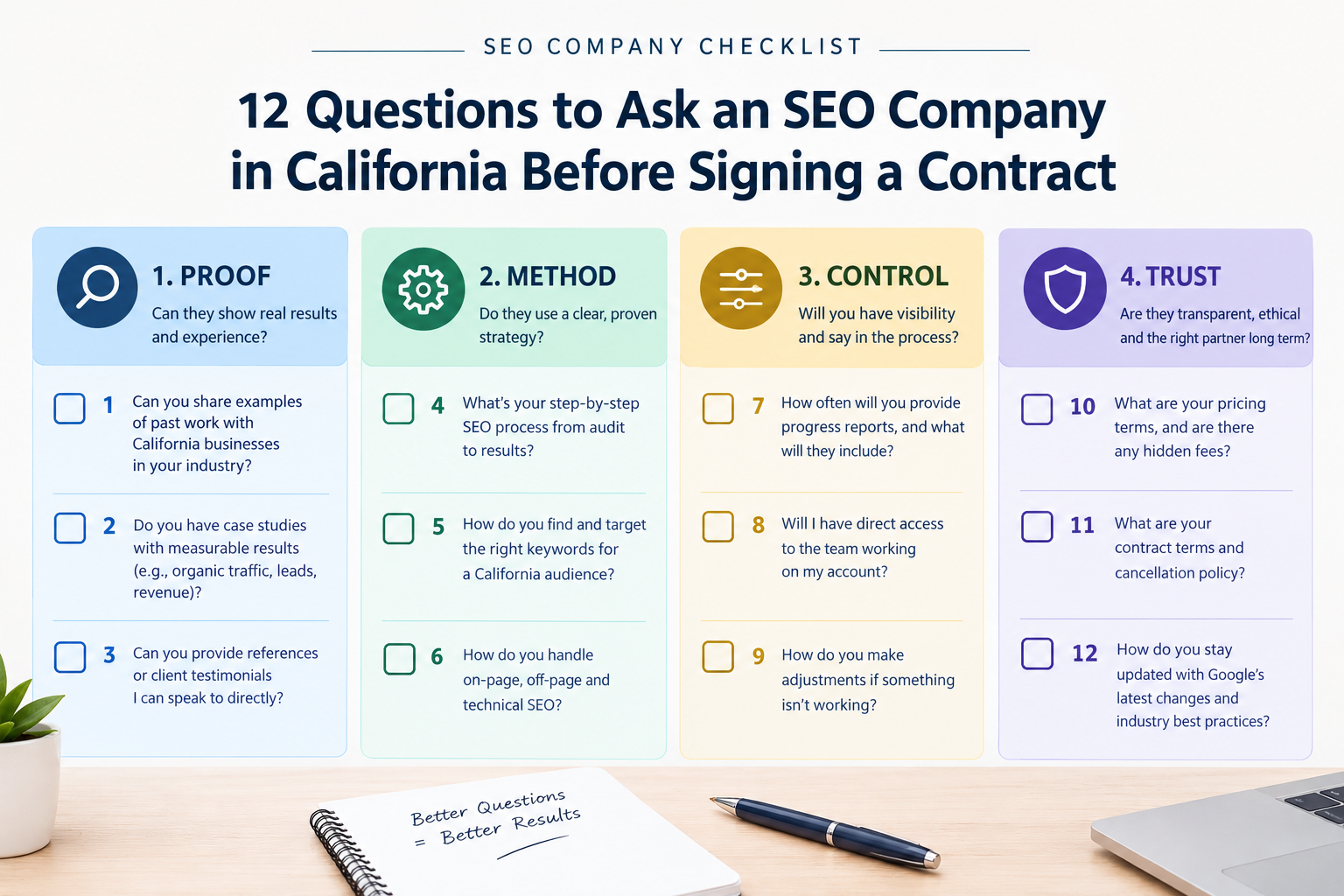
If you are comparing providers, our guide to choosing an SEO company in California lists the twelve questions worth asking before signing anything.
For engagements here, our San Diego SEO services page covers how we structure county-wide campaigns. South Bay businesses should start with Chula Vista SEO instead.
Businesses working across several California metros may also want the LA breakdown, since Los Angeles fragments on different lines.
Frequently asked questions
Should you target San Diego or a specific city?
Target specific cities first for almost every business. A county-wide page competes against the strongest brands across nearly 400,000 businesses, while a city page competes against a handful of local operators. Build three to five pages where you already have customers, then let the county page absorb the authority those pages generate.
How long does local SEO take in San Diego?
Profile corrections such as category, hours and photos can show movement within a few weeks. Competitive city rankings typically take three to six months. Saturated coastal categories like La Jolla aesthetics take longer. Review velocity and local link acquisition are the two factors that most reliably shorten the timeline.
Can one business rank in both Oceanside and Chula Vista?
Rarely in the map pack, because those cities sit roughly 60 miles apart and distance is a top-two ranking factor. You can rank organically in both with dedicated city pages. For map pack placement in both, you generally need a staffed location in each, which is a business decision rather than an SEO one.
Do you need Spanish content to rank in Chula Vista?
If you want the full market, yes. With 57.4% of Chula Vista residents speaking a language other than English at home, English-only pages concede a large share of demand. A genuine Spanish track with correct hreflang beats a translation widget, and Spanish-language reviews reinforce the signal.
How much do affordable SEO services San Diego businesses hire actually cost?
Reputable local SEO in this market generally starts around $900 a month and rises with the number of cities and the competitiveness of the category. Be cautious below that range, since it usually indicates automation rather than manual work. Ask any provider to tie the quote to a specific city list.
What is the single most important Google Maps ranking factor?
In the 2026 expert survey, the primary Google Business Profile category scored highest for the local pack, just ahead of proximity to the searcher. Category is the rare top factor you can correct in minutes, which makes it the first thing to check on any underperforming profile.
Does the local SEO San Diego playbook work for a business with no storefront?
Partly. A service area business hides its address and gets one Google Business Profile for its whole territory, so you cannot open separate profiles for Oceanside and El Cajon. You can still reach the Google Maps pack as a service area business, but city pages on your own site are the mechanism for covering multiple areas.
Ready to find out where your business actually ranks across San Diego County?
Our free 47-point audit shows your current map pack position city by city, delivered in 12 hours with no commitment. Get your free SEO audit.