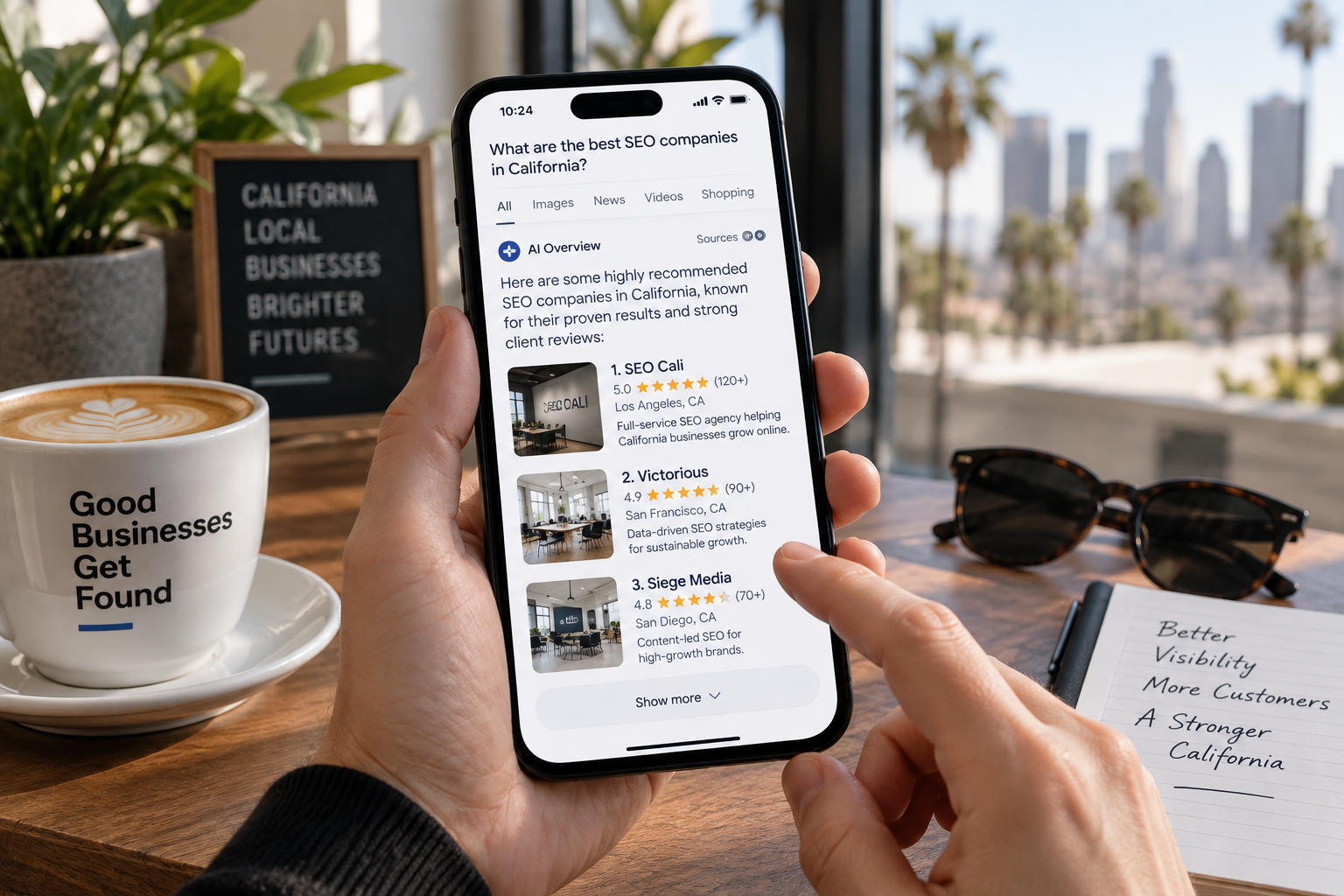

That’s a Google AI Overview. And if your business isn’t one of the sources it pulls from, you’re losing visibility to competitors who are, even if you technically outrank them in the traditional results below.
Google AI Overviews have gone from a quiet experiment to the default experience for a growing share of searches. Industry data from late 2025 showed the feature triggering on roughly 15–25% of all queries, with significantly higher rates in categories like technology, healthcare, and professional services industries that dominate California’s economy. That percentage has only climbed in 2026. For California businesses competing in saturated markets like Los Angeles, San Francisco, San Jose, and San Diego, ignoring this shift means voluntarily surrendering the most visible real estate on Google’s results page.
This guide breaks down exactly what Google AI Overviews are, how Google decides which websites to feature, and the specific steps your California business can take to start showing up in those AI-generated answers. No jargon. No hype. Just the practical playbook we use with California businesses every day.
What Are Google AI Overviews, Exactly?
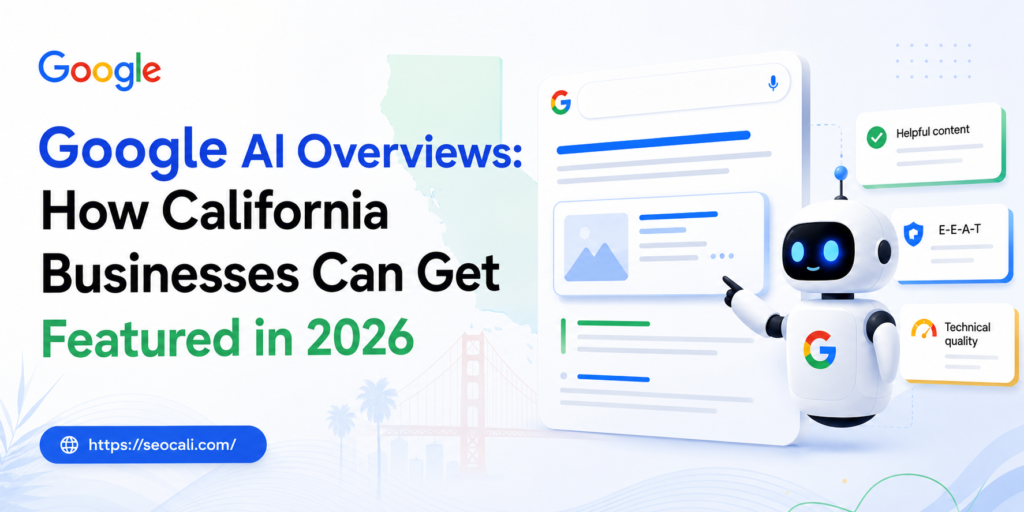
Google AI Overviews are AI-generated summaries that appear at the very top of certain search results. Instead of just showing you a list of blue links, Google reads through dozens of web pages, identifies the most relevant information, and writes a short answer that addresses the searcher’s question directly.
Think of it this way: traditional Google search was like a librarian handing you a stack of books and saying, “The answer is somewhere in here.” Google AI Overviews are like that librarian reading every book in the library and giving you a three-paragraph summary before you even sit down.
These summaries typically include two to four cited sources, with links to the websites from which Google pulled the information. If your website is one of those cited sources, you get visibility that’s arguably more valuable than a #1 organic ranking, because the user sees your brand mentioned inside a trusted AI-generated answer before they ever scroll down to the traditional results.
For California businesses, this matters because the types of searches that trigger Google AI Overviews are overwhelmingly the kinds of searches your potential customers make. Questions like “how much does SEO cost for a small business,” “best dentist in Pasadena for implants,” or “do I need a permit to remodel my kitchen in San Jose” are exactly the high-intent, question-based queries that AI Overviews are designed to answer. If your content isn’t structured to be featured in those answers, someone else’s is.
AI Overviews Ranking Factors: How Google Decides Who Gets Featured
Understanding the AI overviews ranking factors is the starting point for any optimization strategy. Google hasn’t published an exact formula — they never do — but a combination of Google’s own guidance, published research, and what we’ve observed across hundreds of California client campaigns paints a clear picture.
1. You Need to Rank Organically First
This is the part that a lot of “AI SEO” advice glosses over. Google’s own optimization guide, published in May 2026, confirmed what data from Ahrefs and Semrush had already shown: over 75% of URLs cited in AI Overviews also rank in the top 10 organic results for that query. In other words, traditional SEO isn’t optional, it’s the entry ticket. If your pages aren’t ranking well organically, they’re unlikely to be cited in Google AI Overviews regardless of how well-structured they are.
This is why we tell every California business that comes to us asking about AI search optimization: start with your SEO foundation. Technical health, crawlability, site speed, internal linking — all of it still matters just as much as it did before. Our core SEO services cover everything that builds that foundation.
2. Content Structure and Clarity
Google’s AI needs to extract a clean, usable answer from your content. If your page is a rambling 3,000-word essay with no clear structure, the AI will skip it in favor of a competitor’s page that leads with a direct answer and uses clear headings.
What works: starting each major section with a concise, direct answer to the question that section addresses. Think of 40–70 words that a language model could pull directly into a summary without needing to rewrite it. Then expand with supporting detail, data, and context below. Descriptive H2 and H3 headings that mirror the way people actually phrase their searches are critical — they act as signposts that help AI systems navigate your content efficiently.
3. E-E-A-T Signals
Experience, Expertise, Authoritativeness, and Trustworthiness (E-E-A-T) have always mattered for organic rankings. For Google AI Overviews, they’re arguably even more important because Google is essentially putting its own reputation on the line by citing your content inside an AI-generated answer. The bar for trust is higher.
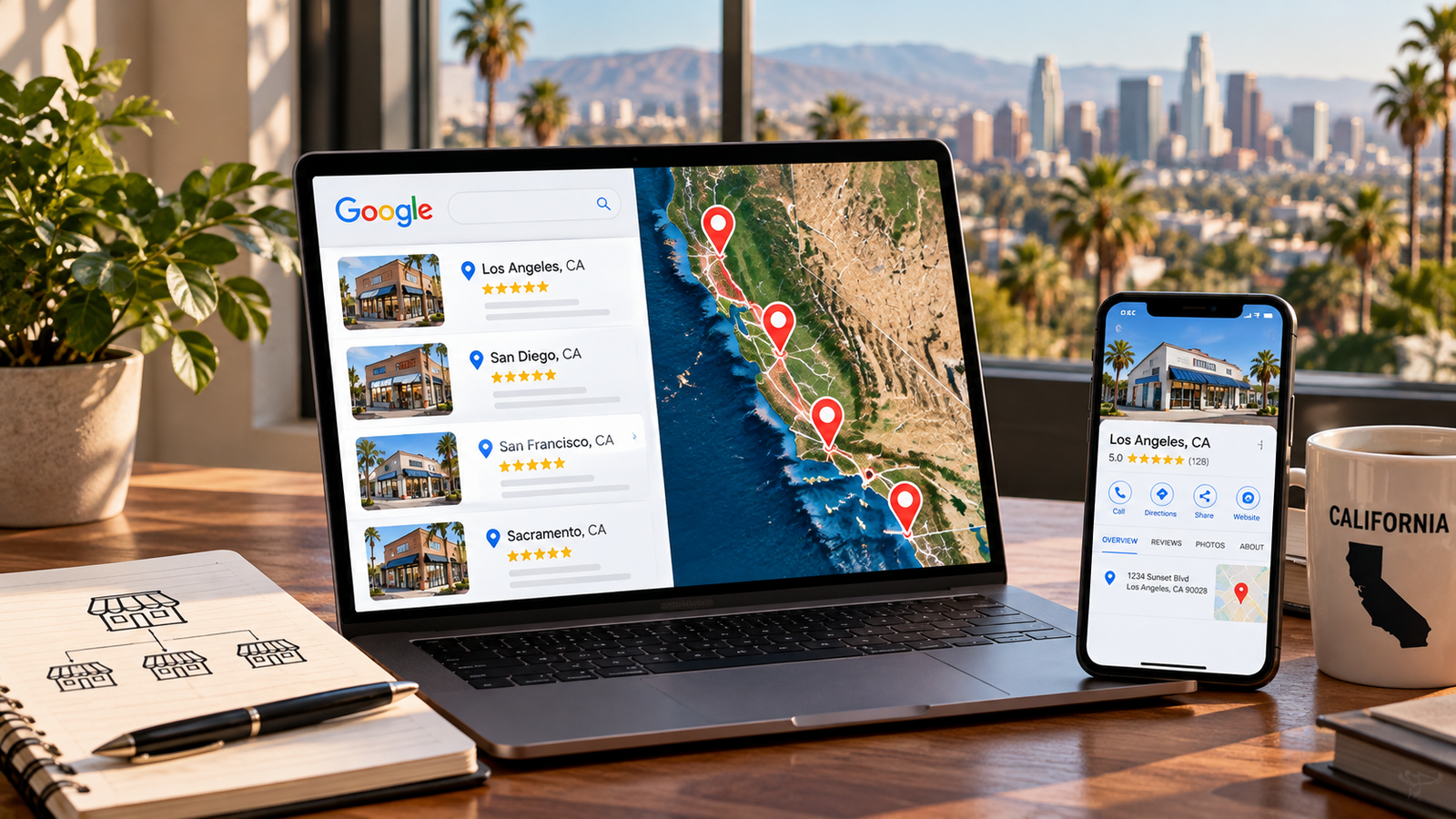
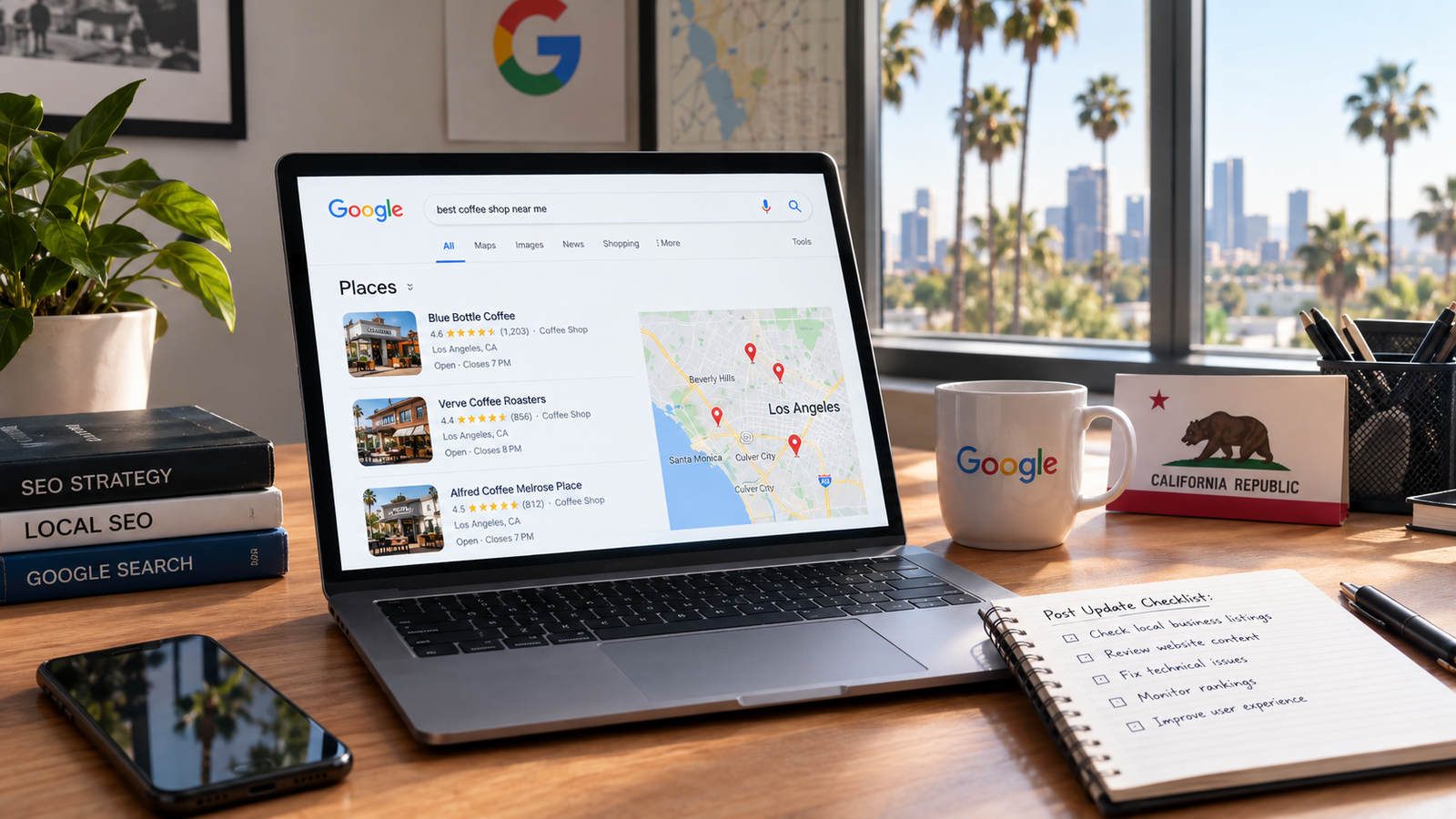
What this means practically: author bios with verifiable credentials, citations to credible sources within your content, backlinks from authoritative California and industry-relevant sites, and content that’s factually accurate and regularly updated. For local California businesses, strong Google Business Profile signals — reviews, accurate business information, local citations — reinforce the trust signals that make Google AI Overviews more likely to cite you.
4. Topical Authority
Google AI Overviews strongly favor websites that demonstrate comprehensive knowledge of a topic, not just a single page. Google’s systems assess whether your site has depth on a subject by looking at how many related subtopics you cover and how well they’re connected through internal links.
This is where a topic cluster strategy becomes essential. A single blog post about “dental implants” won’t carry the same weight as a site that has a pillar page on dental implants, supporting articles on cost, recovery, candidacy, materials, and before-and-after expectations, all interlinked logically. We build exactly this kind of content architecture for our California clients through our content marketing service.
5. Freshness
Google AI Overviews favor sources that appear current. Outdated statistics, old dates in your content, or pages that haven’t been updated in years reduce your chances of being cited. Google’s guide specifically calls out that refreshing a 2024 guide with 2026 data can restore visibility — even if your rankings stayed the same. For California businesses in fast-moving industries like tech, real estate, or healthcare, a content refresh schedule isn’t optional.
How to Improve Visibility in Google AI Overviews: A Step-by-Step Approach
Knowing the ai overviews ranking factors is one thing. Executing on them is where most businesses stall. Here’s the practical framework we use with California clients to systematically improve their Google AI Overview visibility.
Step 1: Audit Your Current AI Visibility
Before you optimize anything, you need to know where you stand. Search for your top 20–30 target keywords in Google and note which ones trigger AI Overviews and whether your site is cited. Tools like Semrush’s AI Toolkit and Ahrefs’ AI Visibility feature now track this automatically, making it easier to monitor Google AI overviews performance over time. Google Search Console also shows some AI Overview impression data now. If you’re not sure where to start, our free 47-point SEO audit includes an AI visibility assessment.
Step 2: Identify Your Best Opportunities
Not every keyword triggers a Google AI Overview, and not every AI Overview is worth targeting. Focus on queries where: an AI Overview already appears (the opportunity is confirmed), your site already ranks on page one (you have the organic foundation), and the query aligns with a high-value service or product. These are your quick wins — pages that need structural optimization, not a complete rewrite.
Step 3: Restructure Your Content for Extraction
For each target page, restructure the content so the AI can easily extract answers. Lead with a direct answer in the first 50–70 words of each section. Use descriptive H2 and H3 headings that match real search queries. Break complex information into short, declarative sentences. Add structured data where appropriate — FAQ schema, HowTo schema, and Article schema all help Google understand what your content covers. Tables, comparison charts, and numbered steps are particularly effective because AI systems can parse them cleanly.
Step 4: Strengthen Your E-E-A-T Signals
Add or update author bios with real credentials. Cite specific data and link to sources. Make sure your Google Business Profile is fully optimized with current information, photos, and a steady flow of reviews. For California businesses, earning mentions and backlinks from local media outlets, chambers of commerce, and industry publications carries extra weight because it reinforces geographic relevance alongside topical authority.
Step 5: Build Topic Clusters
Map out every subtopic related to your core services and create supporting content for each one. Link everything back to a central pillar page. This isn’t just good for Google AI Overviews — it’s the same strategy that improves organic rankings, builds site authority, and gives your content marketing a compounding return over time.
Step 6: Refresh and Monitor Continuously
Google AI Overview citations aren’t permanent. Google’s model changes which sources it references regularly. Set a schedule to refresh key content every three to six months with updated data, current statistics, and any new developments in your industry. Continue to monitor Google AI overview’s performance using the tools mentioned above and adjust your strategy based on what’s working and what’s not.
Why Use AI Search Optimization Tools for Your Business
A common question California business owners ask is whether they really need specialized tools for AI search, or if their existing SEO stack is enough. The short answer: your existing tools are a good start, but they’re not giving you the full picture anymore.
Traditional SEO tools track keyword rankings, organic traffic, and backlinks. They don’t tell you whether your content is being cited in Google AI Overviews, which queries trigger AI-generated answers, or how your visibility compares to competitors in AI search specifically. That gap is exactly why understanding ai overview google seo metrics has become essential for any serious optimization strategy.
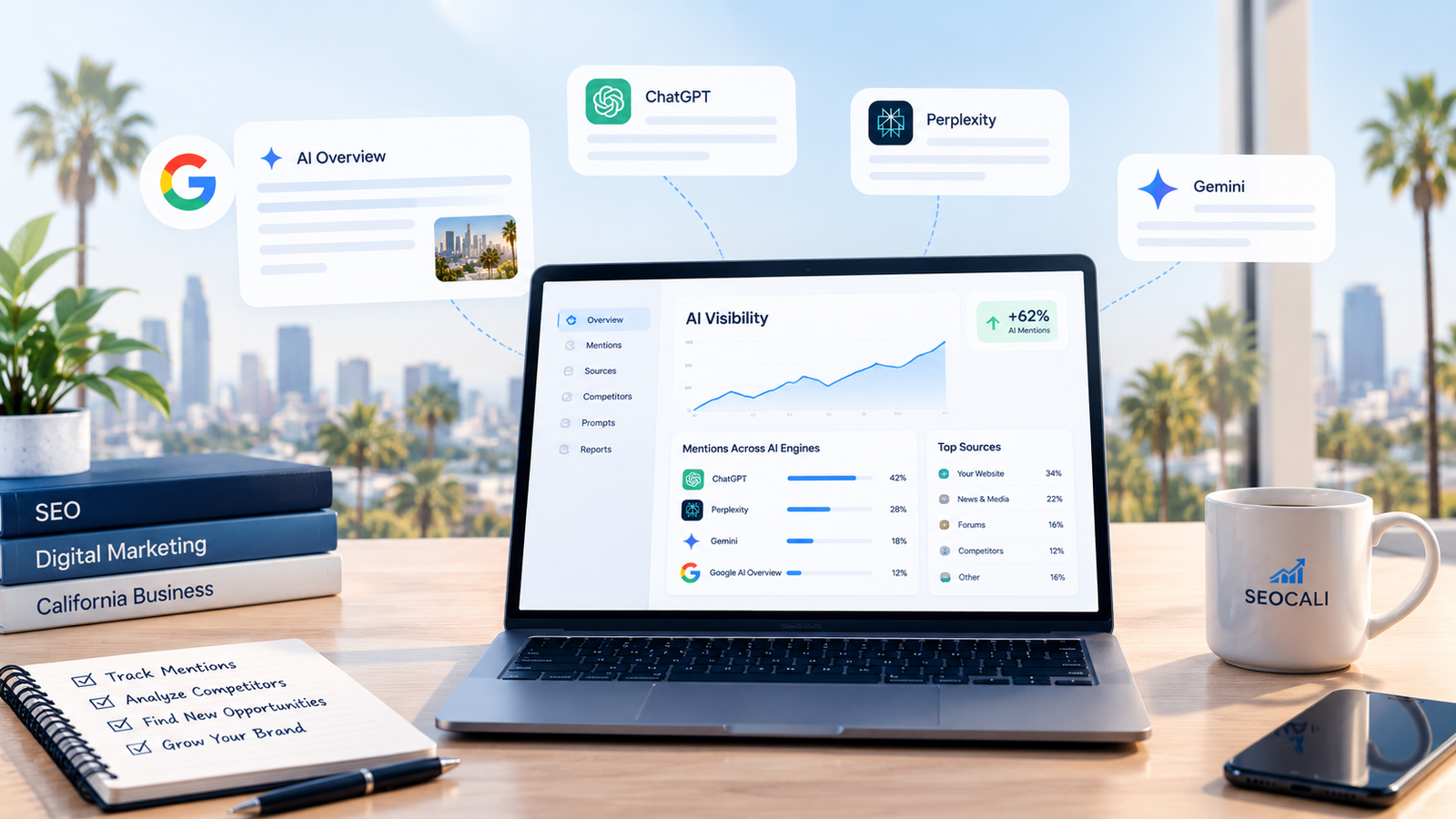
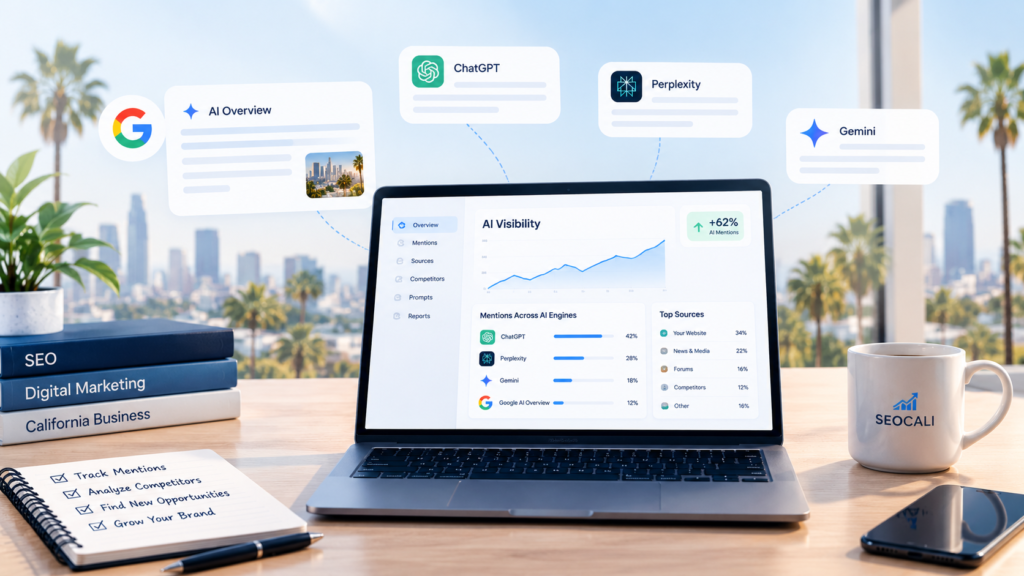
Semrush’s AI Toolkit tracks which of your pages appear in AI Overview citations and measures your “AI share of voice” against competitors. Ahrefs’ AI Visibility feature shows Google AI Overview appearances alongside traditional ranking data, so you can see the full picture in one dashboard. Google Search Console has added AI Overview impression data, giving you first-party data on how often your pages are shown in AI-generated results.
For businesses looking for the best google ai overview analyzer, the most practical approach is combining Semrush or Ahrefs for automated tracking with regular manual SERP checks for your most important queries. Automated tools catch the broad trends; manual checks catch the nuances that tools sometimes miss, like how your content is actually being cited and whether the AI is pulling the right information.
The reason to invest in these tools comes down to a simple reality: you can’t optimize what you can’t measure. California markets are too competitive to rely on guesswork. When your competitors can see exactly where they’re winning AI visibility and you can’t, they’ll outpace you faster than you’d expect.
How Google AI Overviews Are Reshaping California Industries
Google AI Overviews don’t affect every industry equally. In California, the sectors feeling the biggest impact are the ones where customers search with specific questions before making a decision, which is exactly the kind of search AI Overviews are designed to serve.
Healthcare and Dental
Patients searching for cost information, procedure details, and provider recommendations are increasingly seeing AI-generated answers before they reach any individual practice’s website. A California dental clinic that appears inside the Google AI Overview for “how much do dental implants cost in California” gets a trust advantage that’s almost impossible to replicate through traditional rankings alone.
Legal Services
Question-based searches dominate legal marketing. “Do I need a lawyer after a car accident in California?” is a textbook AI Overview query. Law firms that structure their content to answer these questions clearly and authoritatively are getting cited at the top of the page, above every ad and every organic result.
Real Estate
Buyers and sellers ask detailed, market-specific questions that trigger Google AI Overviews constantly. “Is it a good time to buy a house in San Jose?” or “what are closing costs in California?” are the kinds of queries where a well-optimized real estate website can capture visibility that drives serious leads.
Ecommerce
Product comparison searches and “best of” queries frequently trigger AI Overviews with product listings pulled directly from well-structured product pages. California ecommerce brands that implement proper product schema and build comparison content around their categories are seeing measurable traffic from AI citation.Something has quietly changed about Google search in California, and a lot of business owners still haven’t noticed.
The next time you search for something on Google, a plumber in Sacramento, the best CRM for small businesses, or how to file a DBA in California, look at what appears before the first organic result. Chances are, you’ll see a paragraph of text that Google’s AI wrote for you. It pulls information from several websites, synthesizes it into a summary, and presents it right there at the top of the page.
Home Services
Searches like “how much does a roof replacement cost in California” or “best time to install solar panels in the Bay Area” are prime Google AI Overview triggers. Home service companies that build detailed, locally relevant content around these questions are showing up in AI answers ahead of national directories and aggregators. The ai overview google seo opportunity here is enormous because most local contractors haven’t started optimizing for it yet.
Common Mistakes That Kill Your AI Overview Visibility
We audit a lot of California business websites, and the same mistakes come up repeatedly when it comes to Google AI Overview visibility.
Ignoring traditional SEO fundamentals is the most common one. Some business owners hear “AI search” and think it’s an entirely new discipline that replaces everything they know. It isn’t. Google’s own 2026 guidance was explicit: strong SEO is the foundation of AI visibility. If your site has technical issues, slow load times, or weak organic rankings, fixing those comes first — before you even think about AI-specific optimization.
Over-optimizing for AI at the expense of user experience is another trap. We’ve seen sites break their content into tiny, choppy chunks because someone told them AI systems prefer modular content. The result is pages that read like a series of disconnected bullet points — terrible for users, and not actually what AI systems prefer either. Google’s models favor content that’s genuinely helpful to real people. Write for humans first; structure for machines second.
Ignoring structured data is a missed opportunity. While schema markup alone won’t get you into Google AI Overviews, it helps Google understand the context of your content. FAQ schema, HowTo schema, LocalBusiness schema, and Article schema are all signals that improve your eligibility.
Not tracking AI visibility is perhaps the biggest mistake because it means you’re flying blind. If you’re not using tools to monitor Google AI overviews performance for your target keywords, you have no way of knowing whether your optimization efforts are working. Set up tracking before you start optimizing not after.
Publishing and forgetting is the last major issue. Google AI Overviews favor fresh, updated content. A page you published in 2023 and never touched again is losing ground to competitors who update their content every quarter with current data and insights. Build a refresh cycle into your content calendar every three to six months for your most important pages.
Where Google AI Overviews Are Headed And Why Acting Now Matters
Google is not slowing down on AI integration. AI Mode, a more conversational, multi-turn search experience, is rolling out alongside Google AI Overviews and already passed one billion monthly users in 2026. Agentic search experiences, where AI can take actions on behalf of users like booking appointments and comparing products, are in active development.
For California businesses, this means the investment you make in AI search optimization today compounds over time. The content authority, structured data, and brand signals you build now will carry forward into whatever the next evolution of AI search looks like. Businesses that wait until these features are fully mainstream will find themselves trying to catch up to competitors who’ve been building their AI presence for years.
The parallel to early SEO is striking. The businesses that invested in quality SEO in 2005–2010 built domain authority advantages that lasted a decade. The same window exists right now for AI visibility — and it’s closing faster because the technology is moving faster. If you’ve been wondering whether to invest in understanding how to improve visibility in google ai overviews, the answer is now, not next quarter.
The Bottom Line
Google AI Overviews are not a passing trend or a minor feature update. They represent a fundamental shift in how California consumers find businesses, compare options, and make decisions. The businesses that show up in those AI-generated answers will have a structural advantage over the ones that don’t — an advantage that gets harder to close the longer you wait.
The good news is that the path to AI Overview visibility isn’t mysterious. It’s built on the same SEO fundamentals that have always mattered: strong technical health, quality content, genuine authority, and consistent optimization layered with the structural and strategic elements that AI systems specifically need to trust and cite your content.
At SEOCALI, we’ve been helping California businesses navigate these shifts since 2011. We know what works because we track it, test it, and prove it with real numbers from real campaigns. If you want to see where your business stands in AI search right now, our team can show you.
Get your free 47-point SEO and AI visibility audit delivered within 48 hours. We’ll show you exactly where you’re losing ground, what to prioritize first, and how to start capturing the AI traffic your competitors are collecting. No sales pitch, no commitment just a clear roadmap you can act on.
Frequently Asked Questions
What are Google AI Overviews and why should my California business care?
Google AI Overviews are AI-generated summaries that appear at the top of Google search results for a growing number of queries. Instead of just listing websites, Google reads multiple pages and synthesizes a direct answer, citing a handful of sources. If your business is one of those cited sources, you get visibility above every organic result and every paid ad. For California businesses operating in competitive markets, this is the most valuable search real estate available in 2026. If you’re not optimizing for it, your competitors are collecting the leads that should have been yours.
Do I need to do something completely different from regular SEO?
No. Google’s own guidance confirms that strong SEO fundamentals are the foundation of AI visibility. Over 75% of websites cited in Google AI Overviews already rank in the top 10 organic results. What you need to add on top of that foundation is content structured for extraction — clear answers, descriptive headings, schema markup — along with strong E-E-A-T signals and topical depth. Think of it as an extension of good SEO, not a replacement for it.
How long does it take to start appearing in Google AI Overviews?
It depends on your starting point. If your site already ranks well organically and you’re restructuring existing content for AI extraction, results can show within a few weeks to a couple of months. If you’re starting from a weaker SEO foundation, expect three to six months of foundational work before AI visibility becomes realistic. The key factor is organic ranking strength — pages that don’t rank in the top 10 are rarely cited in AI Overviews, so building that base comes first.
Which California industries are most affected by AI Overviews?
Any industry where customers search with specific questions before making a purchase or booking decision is heavily affected. In California, that includes healthcare and dental practices, law firms, real estate agencies, professional services, ecommerce brands, home services, and technology companies. Informational and question-based queries trigger Google AI Overviews at the highest rate, and these are exactly the kinds of searches that drive high-intent leads for California service businesses.
What tools should I use to track my business in Google AI Overviews?
The most effective approach combines automated tracking with manual verification. Semrush’s AI Toolkit and Ahrefs’ AI Visibility feature both track AI Overview citations automatically, making it straightforward to monitor Google AI Overviews’ performance across your keyword portfolio. Google Search Console shows some AI Overview impression data as well. For anyone looking for the best Google AI overview analyzer setup, we recommend supplementing these tools with regular manual searches for your top 10–20 target keywords — automated tracking catches the broad trends, but manual checks reveal how your content is actually being cited and whether Google is pulling the right information.
Can a small California business actually compete in AI Overviews?
Yes, and in many cases, small businesses have an advantage. Google AI Overviews don’t just cite the biggest brand — they cite the clearest, most authoritative answer. A local California business with well-structured, expert content on a specific topic can outperform a national brand that covers that topic superficially. Local signals like Google Business Profile strength, local citations, and geo-specific content also reinforce relevance for California-specific queries. Most small businesses haven’t started optimizing for AI Overviews yet, which means the competition is thinner than you’d expect. The window to establish authority in your local market is still open.