
TL;DR: what you need to know
- A local SEO agency in California helps you win the three things Google weighs in local results: relevance, distance, and prominence.
- California has 4.34 million small businesses, the most of any state, so local competition is dense and changes by region (SBA Office of Advocacy, June 2025).
- 97% of consumers read local reviews, and 47% won’t use a business with fewer than 20 (BrightLocal, February 2026).
- A California address guarantees nothing. Check for named people, market proof, and clear contract terms before you sign.
- One industry survey of 439 providers puts the average local SEO retainer at $1,557 a month (last updated July 2025).
A local SEO agency California business owners can sit down with knows things a remote team has to guess at. It knows which neighborhoods search differently, how reviews tip a decision, and which Google Business Profile categories your competitors are quietly winning with.
We’re a California search engine optimization company, so we’re biased. We’ll say that up front, then try to earn your trust with specifics, including the cases where hiring locally is the wrong call.
Here’s the short version. Local search runs on proximity and proof, and doing SEO in California means handling both across a state too varied for any template.
What does a local SEO agency in California actually do?
A local SEO agency in California helps a business appear in the map results and local listings that nearby customers see on Google. It manages the Google Business Profile, reviews, citations, and location pages that tell Google where you operate, what you do, and why people trust you.
Think of it like the sign over a neighborhood shop. A billboard on the freeway reaches everyone and converts almost no one. The sign on your own street reaches fewer people, but they are already looking for you.
Agencies also call this local search marketing, and a good local search marketing company folds citation cleanup and review management into the same retainer. Our local SEO services cover that ground.
Citations are mentions of your business on other sites, such as directories and chambers of commerce. NAP (name, address, and phone number) is the detail that should never differ between your website and those mentions. Add LocalBusiness schema on your site and the signals line up.
How do relevance, distance, and prominence decide who ranks locally?
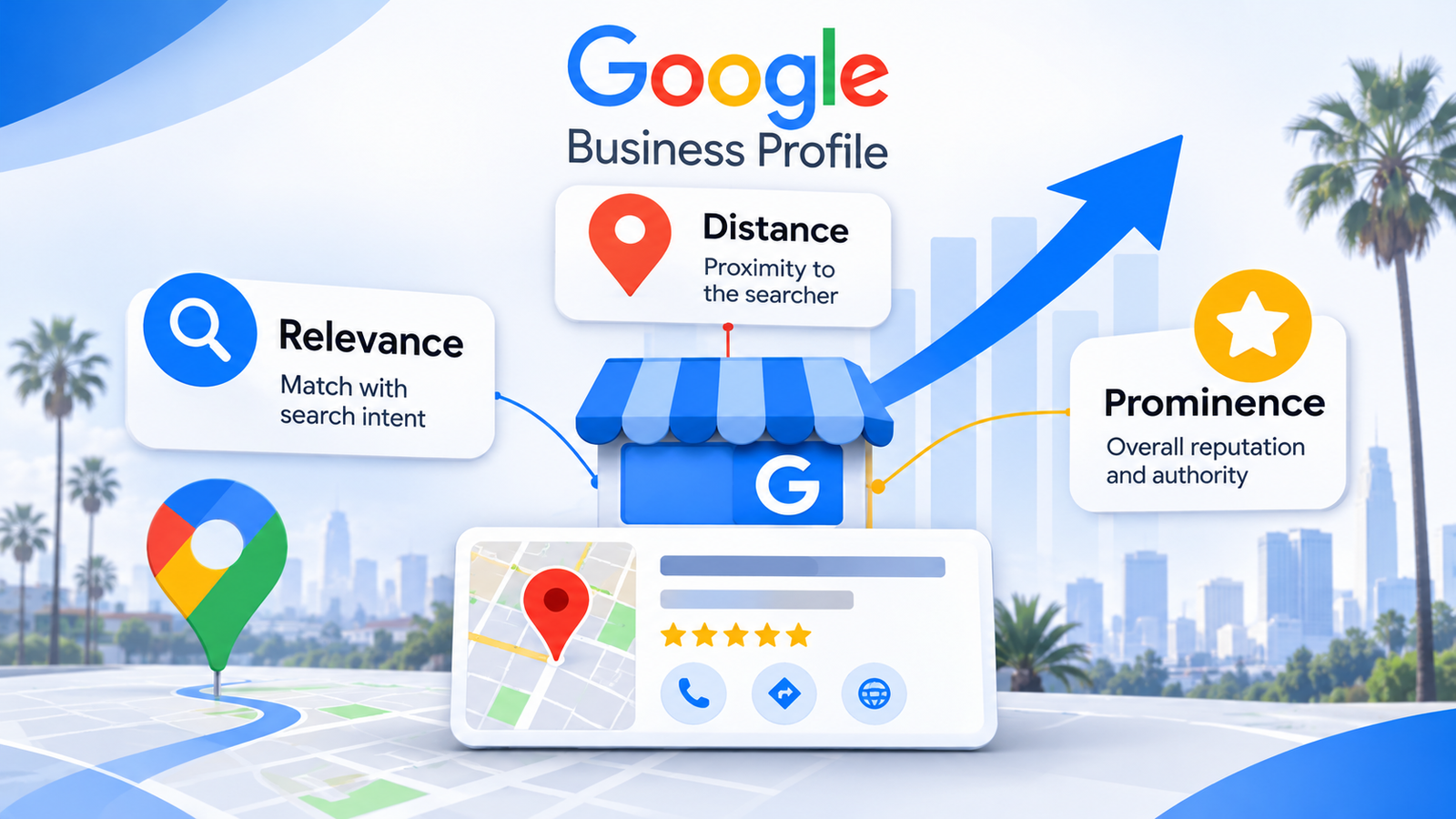
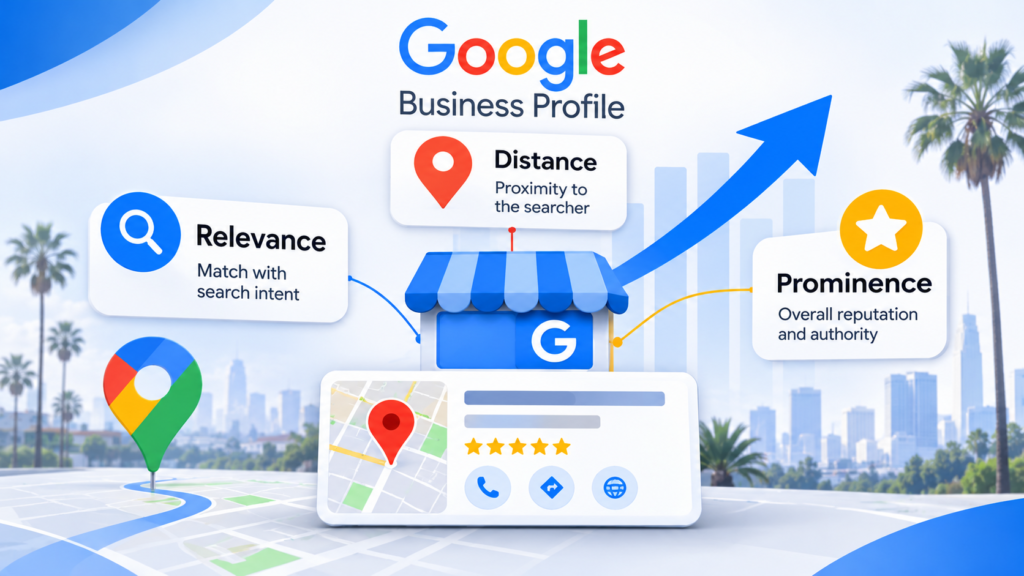
Google ranks local results on three factors: relevance, distance, and prominence. Google’s own Business Profile help page says so directly, and it adds that there is no way to request or pay for a better local ranking.
Relevance is how well your profile matches the search. Distance is how far you are from the person searching. Prominence is how well known you are, which Google measures partly through links, reviews, and mentions across the web.
Picture three judges at a cooking contest. One checks whether you made the dish ordered, one checks whether your kitchen is close enough to deliver it hot, and one asks the neighborhood whether anyone has heard of you. You need all three to nod.
Here’s the part most agency pitches skip. Your agency’s address does not change your ranking, and distance is the one factor nobody can edit. What a local team brings is knowledge of your market, which is what moves relevance and prominence.
Why do reviews and your Google Business Profile matter so much?
Reviews and your Google Business Profile (the free listing behind your map pin) are the two assets most likely to decide whether you appear in the local pack, the short list of businesses Google shows above regular results. They also decide whether a shopper clicks once they see you.
BrightLocal’s 2026 Local Consumer Review Survey, published in February 2026 and based on 1,002 US adults, found:
- 97% of consumers read local reviews, and 41% always do, up from 29%.
- 31% only use businesses rated 4.5 stars or higher, up from 17%.
- 47% won’t use a business with fewer than 20 reviews.
- 74% only care about reviews from the last three months.
- 80% are likely to use a business that responds to all of its reviews.
- The share using AI tools for local recommendations rose from 6% to 45%.
In plain terms, a profile with 90 recent reviews beats one with 14 old ones, even when the second business sits closer. The AI figure above is also why we treat AI search visibility as part of the same job. Assistants draw on the same reviews, listings, and website signals that Google Maps uses.
On the website side, LocalBusiness schema (structured data that gives search engines your business name, address, and hours) backs up the profile. Google’s structured data documentation asks for name and address and recommends the most specific business subtype.
For the profile itself, see our guide to Google Business Profile optimization.
Not sure where your profile and site stand today? Our free 47-point SEO audit is a no-pressure way to find out.
Why is California really five markets, not one?
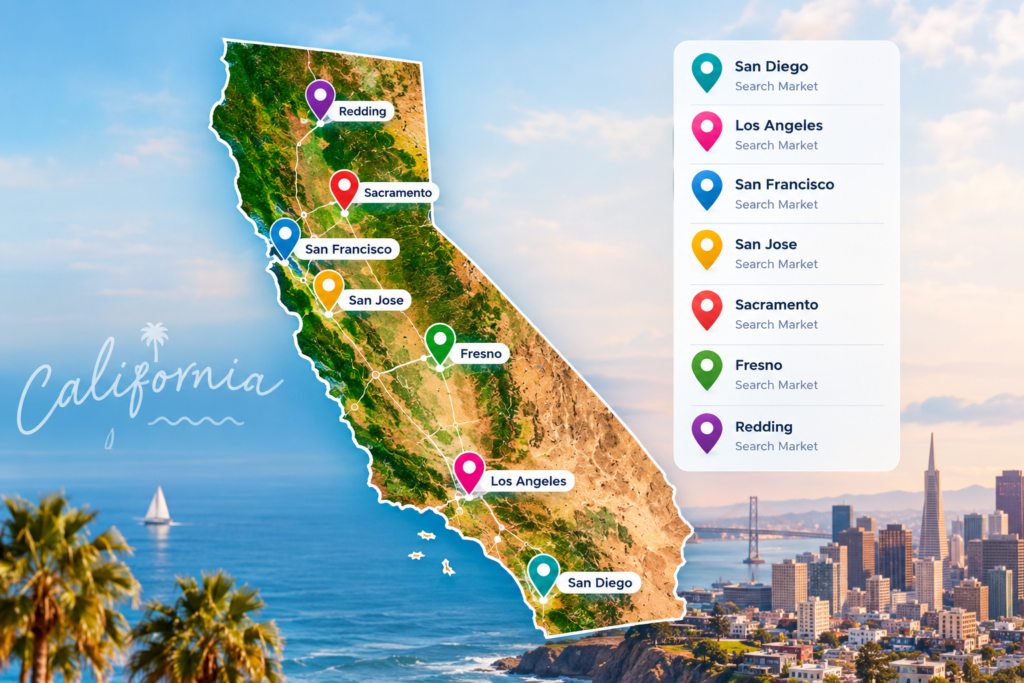
Local SEO California businesses face is really five or more separate markets that share a state border.
The SBA Office of Advocacy’s June 2025 small business report counts 4.34 million small businesses here, the most of any state.
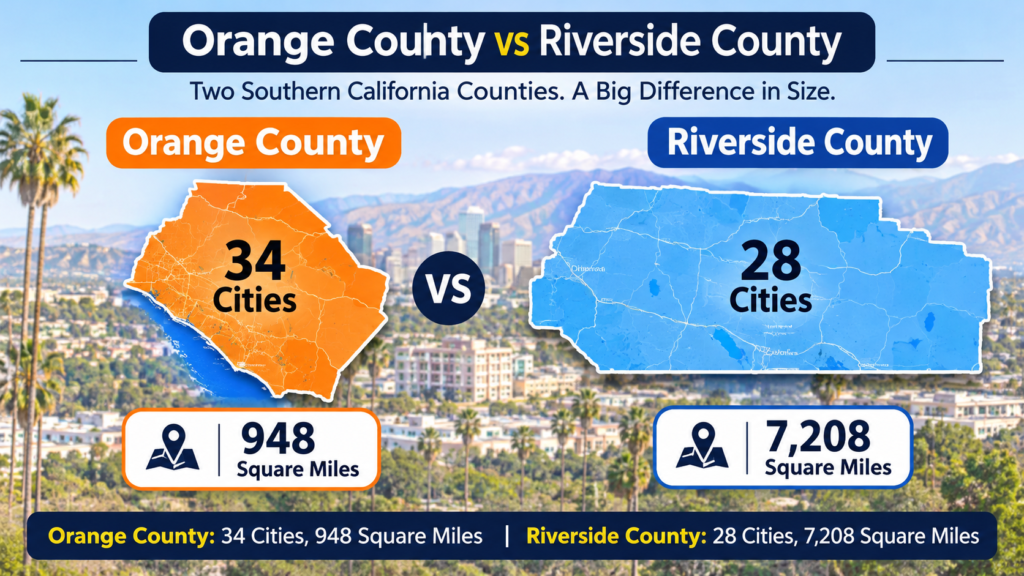
Southern California SEO is mostly a story of sprawl and overlap. Service areas collide, neighborhoods blur together, and the real question is which ones you can serve profitably.
Northern California is different. The best SEO company in Northern California for a Bay Area software firm is not automatically the right fit for a Central Valley equipment dealer. Same state, different buyers, different review pools.
Here’s how we sort the main markets:
- Los Angeles and Orange County: dense, overlapping service areas, covered on our Los Angeles page.
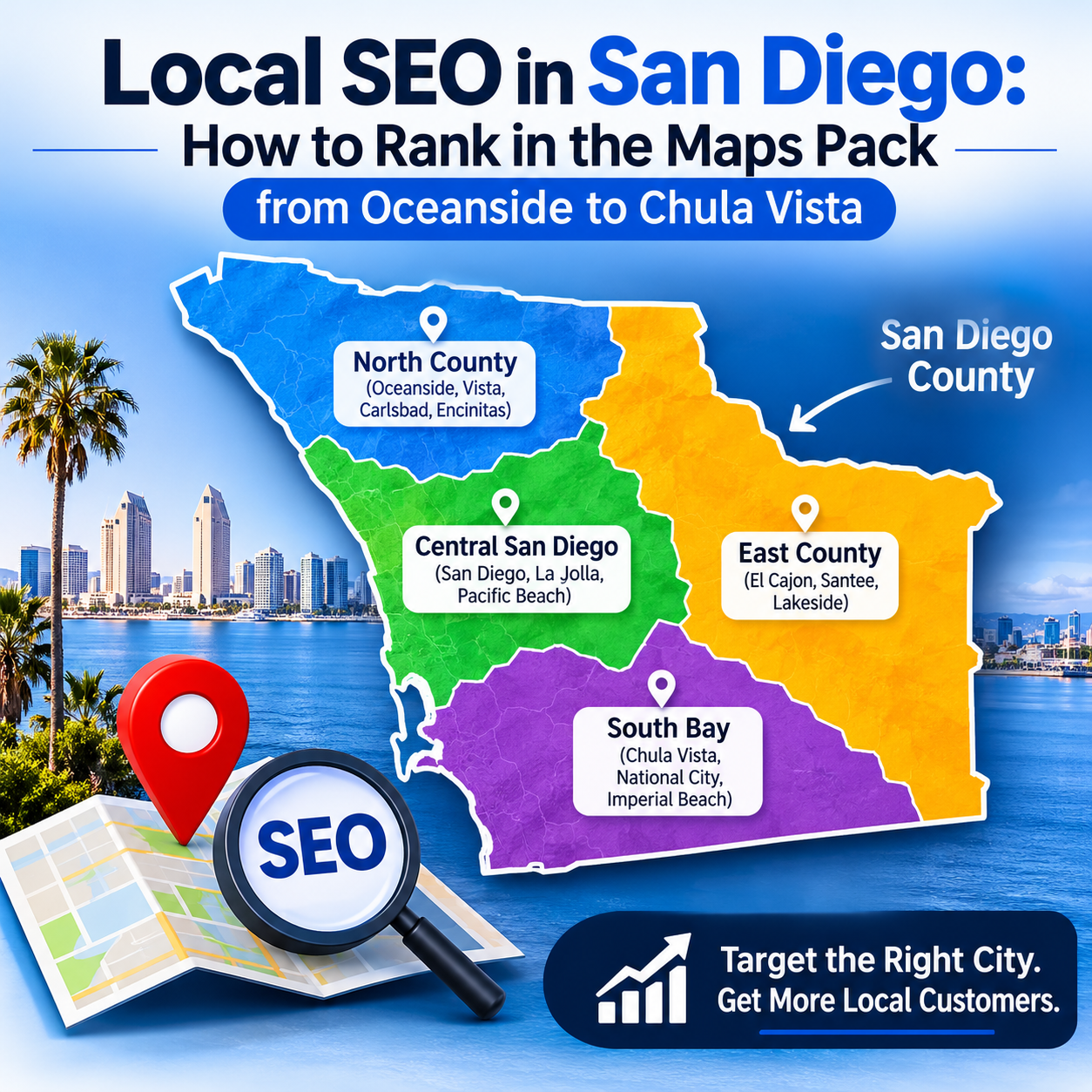
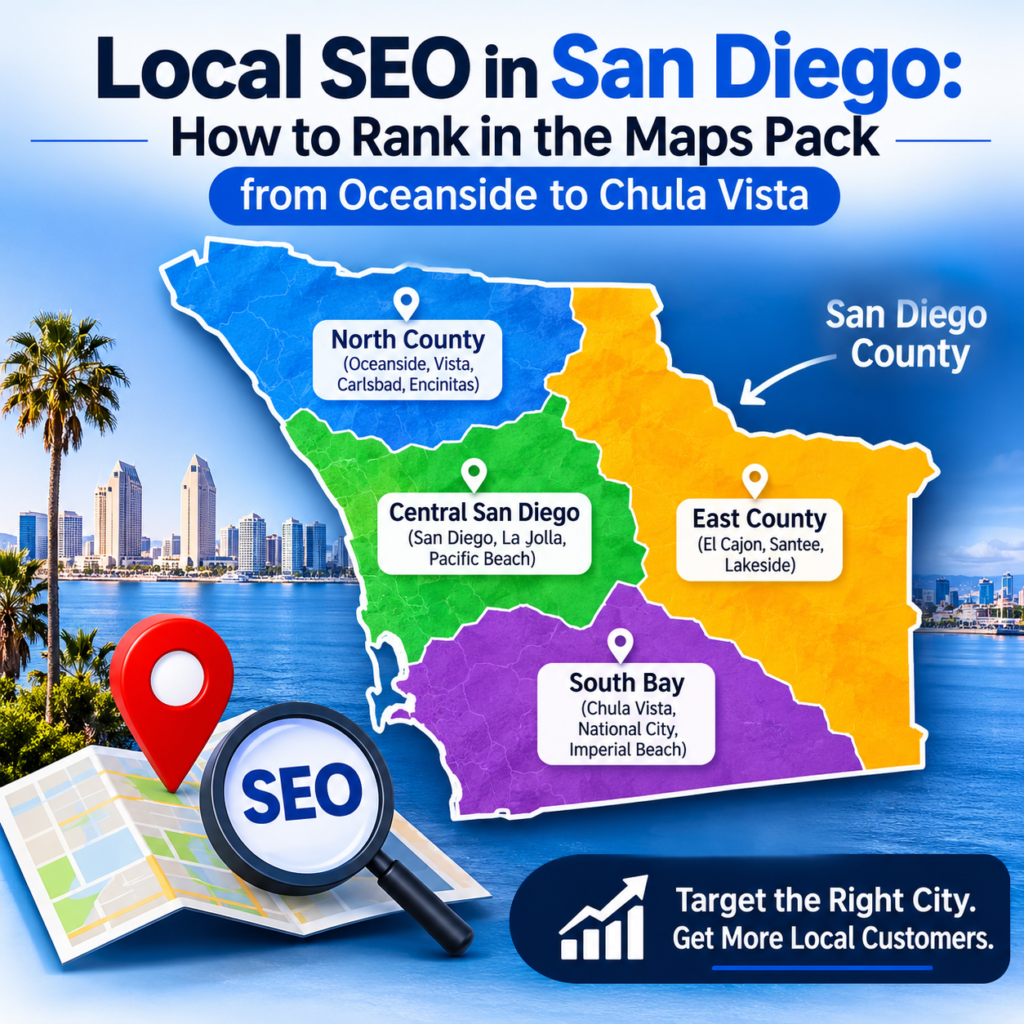
- San Diego: a more contained metro, see our San Diego page.
- The Bay Area: tech-heavy buyers who research hard, see San Francisco.
- Sacramento: the capital region, with Sacramento competitor sets that can be smaller.
- The Central Valley: customers who search differently and drive further, see Fresno.
Our opinion is simple. An agency that pitches the same plan for Fresno and San Francisco is selling a template.
Operating in several markets? Our multi-location SEO strategy post shows how to avoid thin location pages.
Google’s spam policies treat doorway pages, near-duplicate pages made to catch searches in many cities, as abuse.
Does being based in California guarantee better SEO results?
No. An address is not a track record, and we would rather say that now than have you find out after signing.
We can point to one example. Sacramento’s BrightSmile Dental Group reached the number one spot in Google Maps for its market, and the write-up sits in our case study library.
One case proves we can do it, not that we can do it for you. Your category, your competitors, and your starting point set the pace, and nobody can promise you position one.
When is a national or out-of-state agency the better call?
A national or remote agency is the better call when your business spans many states, needs a narrow specialty, or depends on tooling a small team doesn’t have. A local California agency is the better call when your customers, staff, and competitors all live in the state.
| Your situation | Likely better fit |
| Customers in a handful of California cities | Local California agency |
| Locations across many states | National agency |
| Regulated niche needing deep specialist knowledge | Whoever has proven niche results, wherever they sit |
| You want regular in-person strategy meetings | Local California agency |
| Enterprise reporting across hundreds of locations | National agency |
Prioritize a local California agency if your revenue comes from customers within a few hours’ drive. Prioritize a national team if your footprint crosses state lines or your niche is specialized enough that location is a distant second.
We think California businesses underrate how much market knowledge matters. Our breakdown of how we differ from national agencies shows where we draw the line.
What should you check before hiring a local SEO company in California?
Before hiring a local SEO company in California, verify where the agency really operates, who does the work, what proof they have in your market, and how they report. Use this checklist.
- Verify the address. Look the agency up on Google Maps. Google’s Business Profile guidelines say a profile must reflect a real-world location, and a virtual office does not qualify.
- Ask who does the work. Request the names of the California SEO professionals who will touch your account, not just the salesperson.
- Ask for proof in your market. Look for clients in a similar city and category, with real before-and-after numbers you can check.
- Read the agency’s own reviews. Sort by newest, and notice how the owner responds to complaints.
- Read the contract. Month-to-month terms mean the agency has to keep earning its retainer.
- Demand useful reporting. A spot in the local pack only matters if it produces calls, direction requests, and form fills.
Looking for the best local SEO services company California has to offer? Treat those six checks as your scorecard, because the answer depends on your city and category more than any ranked list.
For a deeper walkthrough, read our guide to finding a trusted SEO specialist in California
What does local SEO cost in California?
One industry pricing survey of 439 providers, last updated in July 2025, puts the average local SEO retainer at $1,557 a month. Agencies averaged about $1,819 and freelancers about $1,150.
California SEO services range widely beyond that average, since a Bay Area law firm and a Bakersfield HVAC contractor don’t buy the same scope. Our own plans run from $900 to $3,000 a month, billed month-to-month with no lock-in.
For what drives price up or down, see our guide to affordable SEO options in California
Frequently asked questions
Is a local SEO agency worth it for a small business in California?
Usually yes, if customers search for you by city or neighborhood. Local results send ready-to-buy customers to profiles that rank well and have fresh reviews. It is less worthwhile if most of your sales happen online outside California. Start with an audit before committing to a retainer, so you know whether the upside justifies the spend.
What is the difference between local SEO and regular SEO?
Regular SEO helps a website rank in standard search results for topics and products. California local SEO focuses on map listings and location-based searches, so it relies on your Google Business Profile, reviews, citations, and NAP consistency as much as on your site. Most businesses with a physical presence or service area need both.
How long does local SEO take to work in California?
It depends on your category and city. In our experience, a few months is realistic for a mid-sized market, and crowded categories in Los Angeles or the Bay Area take longer. Be wary of any agency that promises a date, because Google says there is no way to pay for a better local ranking.
Can a local SEO company guarantee first-page rankings?
No. Google says plainly that no one can pay for a better local ranking, so a guarantee is a warning sign. Ask instead what the agency will do each month, how it will measure calls and leads, and what happens if the numbers stall. Honest agencies talk about effort and measurement, not outcomes they cannot control.
The bottom line: choose proof over proximity
A local SEO agency in California gives you market knowledge, accountability, and people you can reach. It does not give you results by default, so verify the address, the team, and the track record.
If your customers live in California, start with a local team that can show work in markets like yours. If you operate across many states, weigh a national option too. Either way, compare scopes in writing.
Ready to see where you stand? Book our free audit today.
Prefer to compare options first? Look at our Local SEO service.
SEOCALI is at 600 California St, San Francisco, CA 94108. Call +1 (628) 555-3221 or email info@seocali.com, Monday to Friday, 9am to 5pm Pacific.
Questions before you book? Contact us.