
30-Second Summary
- The Google September 2026 spam update started on September 24 and finished early on October 8, a rollout of just under 14 days.
- It is the fourth Google spam update of 2026 and by far the longest. The three before it each ended within about three days.
- Google did not say what it targeted. Early reports from experienced SEOs pointed at templated, programmatic pages, which is how many city pages are built.
- Spam updates are automatic. Google sends no message, and the Manual Actions report will not show an algorithmic demotion.
- Check Search Console by page type, fix the weakest template first, and expect Google spam update recovery to take months, not days.
Your leads may have shifted at some point in the last two weeks, and the cause may not be your website at all. Google spent almost 14 days rolling out a spam update that moved rankings in waves. Now that it is over, you can finally measure the damage, or the lack of it.
We are a California local SEO agency, so we wrote this for owners who need a plain answer: what changed, what to check, and what to leave alone.
What Was the Google September 2026 Spam Update?
The Google September 2026 spam update is a change to the automated systems Google uses to find spam in search results. Google released it on September 24, 2026 at 9:15 in the morning Pacific Time. It applies worldwide and to every language, and the Search Status Dashboard shows the rollout finished on October 8.
The company says its spam detection runs all the time. Now and then it improves those systems and calls the change a spam update. Think of SpamBrain, Google’s AI based spam prevention system, as a bank’s fraud detector. An update is the bank teaching it new patterns.
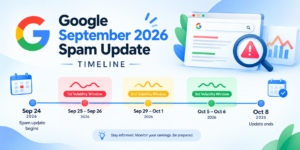
Rankings did not move evenly. Search Engine Roundtable tracked volatility in three windows: September 25 to 27, around September 30, and October 4 to 6. Those waves were not confirmed, so treat them as outside observations.
How the 2026 spam updates compare
| Update | Dates | Rollout length |
| March 2026 | March 24 to 25 | Under 20 hours |
| June 2026 | June 24 to 26 | About 2 days |
| August 2026 | August 18 to 21 | About 2 days 16 hours |
| September 2026 | September 24 to October 8 | Just under 14 days |
Did Google Spam Update Hit My Site? Five Checks Before You Change Anything
Compare Search Console clicks for the weeks after September 24 against the weeks before, then split the losses by page type. An even decline that matches last year usually points to seasonality. A sharp drop on one group of pages, such as all your city pages, is the pattern worth investigating.
- Wait for the right window. Advice written for core updates, which works well here too, is to wait about a week after a rollout ends before comparing. That puts your cleanest read after October 15.
- Compare like with like. In the Search Console Performance report, compare the period after September 24 with the previous period and with the same dates last year. Widen the range to 16 months to rule out seasonality.
- Split by search type and page. Filter to Web, then sort the Pages table by click difference. Group the losing URLs by template: city pages, service pages, and blog posts.
- Check Manual Actions and Security issues. A clean Manual Actions report does not clear you. It only lists actions taken by human reviewers, not algorithmic ones.
- Rule out the boring causes. Compare Search Console with GA4, then list every deploy, plugin update, and redirect since September 1. If you find crawl or indexing errors, start with technical SEO before you touch content.
If nothing moved, do nothing. The guidance says to avoid drastic changes after a small position drop, especially on pages that perform well.
Local owners should check one more place. Search Console covers web search clicks, while calls and direction requests from your Google Business Profile live in a separate dashboard.
“We are reviewing Search Console data by page type for the California sites we manage, and we will update this article if a clear pattern shows up. Until then, we treat the early reports about templated pages as a lead to test, not a conclusion.”
![Search Console performance report comparing clicks before and after the September 24 2026 spam update]](https://seocali.com/wp-content/uploads/2026/10/Search-Console-Spam-Update-Comparison-300x150.png "Google September 2026 Spam Update Is Done: What California Local Sites Should Check Now 2")
What Did the Spam Update Target? Google Has Not Said
Google named no target, and it has not said what SpamBrain was taught this time. Its dashboard entry says only that the update applies globally and to all languages. Barry Schwartz of Search Engine Roundtable wrote that the tactics involved are not fully known and that several are likely affected.
Early reports are still worth knowing. Lily Ray saw signs that highly templated, programmatic pages took hits, such as one page per phone number or area code. Glenn Gabe reported big drops across a number of sites in several verticals and countries.
Those are early observations from experienced SEOs, not Google’s confirmation. They do describe how many local sites are built: one template repeated across dozens of cities. That is why city pages are the first thing we would audit after any spam update local business owners hear about.
Spam Update vs Core Update: Which One Is It?
A spam update targets pages that break Google’s spam policies. A core update changes how Google’s ranking systems judge quality across the web, and it can move sites that did nothing wrong. The spam update vs core update difference matters because the fix is different.
Picture a restaurant guide. A core update is the guide rewriting how it scores every restaurant. A spam update is a health inspector sweeping through kitchens that break the rules.
| Question | Spam update | Core update |
| What is it for? | Catch content that breaks spam policies | Re-evaluate quality and relevance broadly |
| Who does it hit? | Mostly sites tied to violations | Any site, including clean ones |
| Does Google notify you? | No | No |
| 2026 rollouts | March, June, August, September | March 27 to April 8, May 21 to June 2 |
| Typical fix | Fix the violation, then wait for systems to relearn | Improve overall quality and wait for the next update |
Could a core update follow? At the time of writing, none has been announced after this spam update. In March, a core update began three days after that month’s spam update started, so back to back updates do happen.
A spam update does not predict a core update, though, and no schedule is published. Check the Search Status Dashboard rather than guessing.
Doorway Pages Local SEO Risk: Are City Pages Spam?
Doorway pages local SEO risk is real, but city pages are not spam by default. They become a problem when each page exists to catch a search instead of helping a customer in that city.
Google’s spam policies define doorway abuse as pages created to rank for specific, similar search queries. One example Google lists is pages targeted at specific regions or cities that funnel users to one page.
Scaled content abuse is a separate policy. Google defines it as many pages generated mainly to manipulate rankings, and it names using generative AI tools to produce many pages without adding value. Google’s wording does not mention city pages.
The scaled content abuse local business risk is the pattern, not any single page: fifty pages, one template, no new information. Google publishes no minimum difference between pages, so the tests below are our judgment, not a Google rule.
The Swap Test: Is This City Pages Spam?
Open one city page. Replace the city name with another city. If the page still reads fine, it is a doorway candidate, because nothing on it belongs to that city. Real local detail does not survive the swap.
| Weak signal | Stronger signal |
| Same paragraphs with the city name swapped | Copy written from real work in that city |
| Long lists of nearby towns and zip codes | Named projects or customers served there, with permission |
| Stock photos and a generic map | Original photos and clear service area details |
| Every page pushes to the same form | Page answers local questions before asking for a call |
| Invented neighborhood facts | Facts you can source, such as local rules or pricing differences |
California makes this harder because metro areas blur together. Long Beach, Anaheim, Santa Ana, and Irvine all sit within a short drive of Los Angeles, so a business can easily publish five near twins. Our California local SEO city guide shows how to separate markets that genuinely differ.
What Should You Do With Each City Page?
Decide by template, not page by page. Start with the group that lost the most clicks, then give every page one of four outcomes.
| Outcome | Use it when | What to do |
| Keep | The page passes the swap test and brings leads | Leave it alone and keep it fresh |
| Rewrite | You serve the city, but the copy is generic | Add real jobs, reviews, photos, and local questions |
| Merge | Nearby cities say the same thing | Combine them into one stronger page and 301 redirect the old URLs |
| Remove | You have no real service there and no traffic | Remove it and redirect to the closest useful page |
Core update guidance calls deleting content a last resort, and that logic holds when a page still serves real customers. Rewrite first. Remove only what has no reason to exist.
Which Google Spam Policies Local SEO Owners Should Read First?
The spam policies page, last updated August 28, 2026, lists 16 policies. Most local sites only need to check five of them.
| Policy | What it can look like on a local site | Quick check |
| Doorway abuse | Near identical city or service pages that funnel to one page | Run the swap test |
| Scaled content abuse | Dozens of pages produced fast that add nothing new | Compare publish dates and templates |
| Keyword stuffing | Footers or paragraphs packed with city names and zip codes | Read the page aloud |
| Link spam | Paid links, link swaps, or directory blasts | Review the Links report in Search Console |
| Hacked content | Injected pages or redirects on a WordPress site | Check Security issues and search your own domain for odd pages |
Not sure how your pages score? Our SEO audit covers templates, links, and technical health in one pass.
How Long Does Google Spam Update Recovery Take?
Recovery can take months. The spam updates documentation explains that automated systems need time to confirm a site now follows the policies. Because a spam update is automatic, there is no person to appeal to.
Here is the order we would work in. This pacing is our suggestion, not a Google timeline.
- Save the evidence. Export Search Console data for the weeks before and after September 24, by page and by query.
- Fix the worst template first. One strong rewrite of the template beats fifty small edits.
- Log every change with its date. Without a log, you cannot tell what worked.
- Give changes weeks to be recrawled, then judge over months. Recheck after Google announces its next spam or core update.
- Keep publishing real pages. Add content only when it answers a question your customers actually ask.
One warning on links. When spammy links are neutralized, the documentation says the ranking benefit those links gave is lost and cannot be regained. A link problem is a different job from a page quality problem, and our local SEO work treats them separately.
Frequently Asked Questions
When did the Google September 2026 spam update start and end?
Google released the update on September 24, 2026 at 9:15 in the morning Pacific Time. The Search Status Dashboard lists the end as 1:00 in the morning on October 8, with a completion note about half an hour later. The rollout lasted just under 14 days. Wait about a week after the end before you judge your data.
Does Google notify sites hit by a spam update?
No. Spam updates are algorithmic, so Google sends no message through Search Console. The Manual Actions report only lists actions applied by human reviewers, so an empty report does not prove your site is safe. Compare Performance report data by date and page type instead of waiting for a warning that will not arrive.
Are city pages considered spam by Google?
Not by default. The doorway abuse policy targets pages built to rank for similar queries and funnel visitors onward, and it lists region or city targeting as one example. City pages with real local work, reviews, and details are fine. Pages where only the city name changes are the ones at risk.
How long does recovery from a spam update take?
Recovery can take months because automated systems must learn that your site now follows the policies. Fix the worst template first, log every change with its date, and judge results over months, not days. Quick fixes rarely help, and panic edits can hurt pages that were performing well. Patience and a clean change log matter more than speed.
Should you delete thin city pages?
Only as a last resort. If you serve the city, rewrite the page with real jobs, reviews, and local questions. If nearby pages say the same thing, merge them and redirect the old URLs. Remove a page only when you have no real service there and the page earns no traffic or leads.
Will a core update come after the spam update?
Nobody outside Google knows. At the time of writing, Google has not announced one after the September spam update. A core update did start three days after the March spam update, so the pattern exists, but a spam update does not predict a core update. Watch the Search Status Dashboard instead of rumors.
What if your traffic did not change?
Then leave your site alone. The guidance says to avoid drastic changes after a small drop, and it applies even more when nothing dropped. Annotate September 24 to October 8 in your reports, run the swap test on your city pages when you have time, and keep your normal publishing schedule.
Was this a link spam update?
No. It was announced as a spam update, not a link spam update. Link spam updates are a separate type that neutralize the value of spammy links, and the documentation says that lost value cannot be regained. You should still review your backlinks, because the general spam update can overlap with other policies.
Bottom Line: What to Do This Month
Cheat sheet
| When | What to do |
| Now through October 15 | Annotate the rollout dates, check Manual Actions and Security issues, list every site change since September 1, and compare Google Business Profile insights with web clicks |
| October 15 to October 31 | Compare Search Console periods, group losses by template, and run the swap test on city pages |
| November onward | Rewrite, merge, or remove by template, log each change, and recheck after the next announced update |
The Google September 2026 spam update is over, but the evidence is still fresh. If your data shows a drop on one page type, you have a place to start. If it shows nothing, you now know where your biggest risk sits.
No one has confirmed what it targeted, and we will not pretend to know. What we can say is that thin, repeated local pages were a risk before this update and still are. Real local detail is the safer bet for any California local business.
Want a second opinion on your city pages? Ask us for a free SEO audit, and we will show you which pages pass the swap test. You can also contact our team with questions about your Search Console data.
Last updated: October 10, 2026. This article covers the update as of its completion on October 8, 2026, and we will revise it if Google announces a core update.