
THE 30-SECOND VERSION
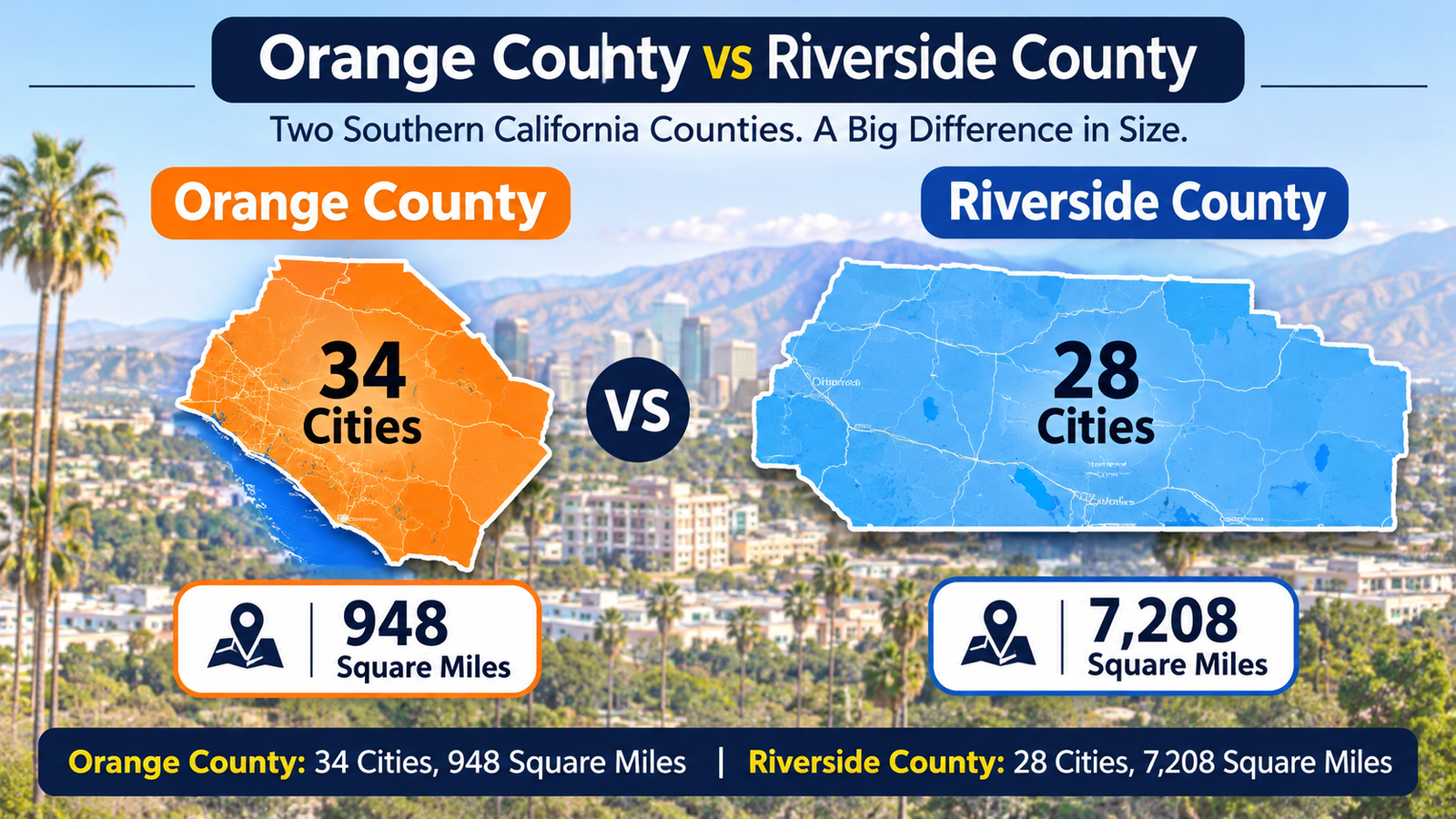
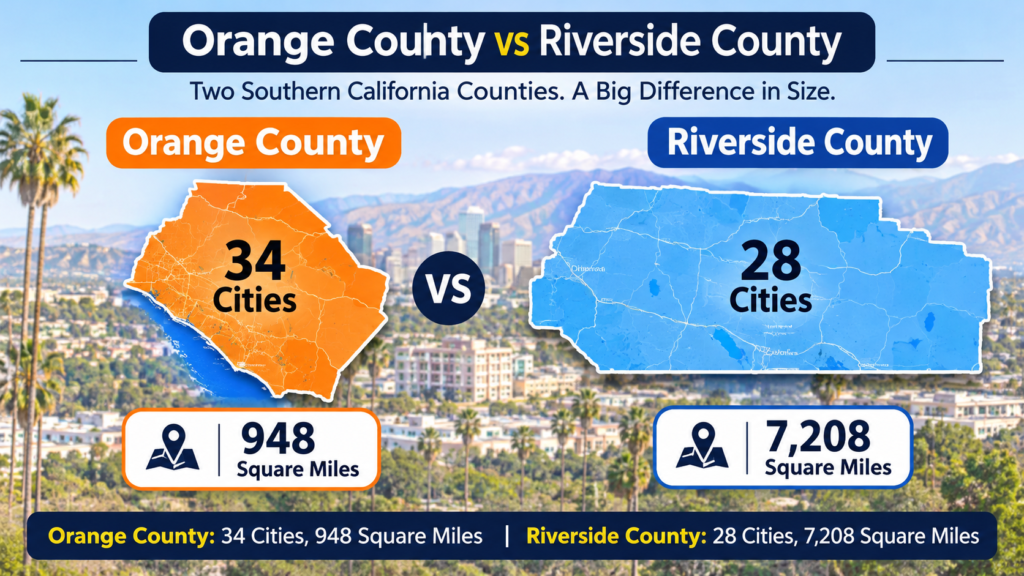
- Local SEO in Orange County and local SEO in Riverside are not the same job. Orange County packs 34 incorporated cities into roughly 948 square miles. Riverside County spreads 28 cities across 7,208 square miles.
- Density decides your tactics. In Orange County, a competitor two exits down the 405 beats you on proximity alone, so city-level pages win. In Riverside, the problem is the opposite: one profile cannot legitimately cover Corona and Blythe.
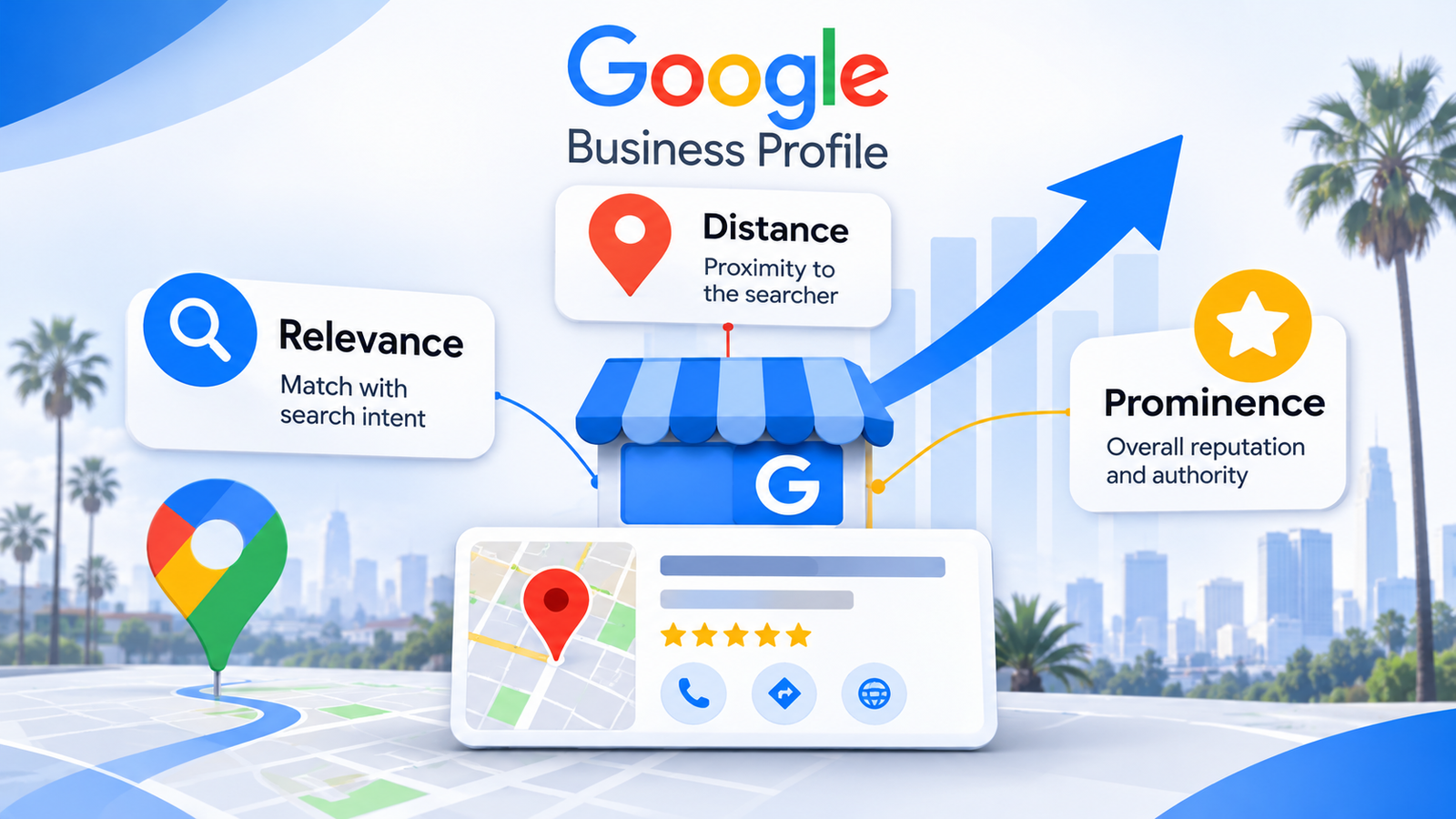
- Google names three local ranking inputs: relevance, distance and prominence. It also says there is no way to pay for better local placement.
- Your primary Google Business Profile category scored highest in the 2026 expert survey, just ahead of proximity. Category is free to fix in about four minutes.
- Service-area businesses get one profile for their whole territory, capped at 20 areas and roughly two hours of driving time. That cap bites hard in Riverside County and barely registers in Orange County.
Running a local business across these two counties means competing in two markets that happen to share a border and nothing else.
A plumber in Fullerton and a plumber in Hemet are both doing “local SEO,” but almost none of the work transfers. The Fullerton operator is fighting for inches. The Hemet operator is fighting for miles.
We have run California-only campaigns since 2011, and this is the pattern we see most often across the Inland Empire and the OC: one strategy, written once, pointed at a county name, producing nothing in either market.
Here is our flat opinion. Stop building county pages. Build city pages for the three to five cities where you already close business, and let the county page inherit the authority those pages earn.
This Orange County local SEO guide covers both counties in the order the work should actually happen: understand the geography, fix the profile, build the city layer, then measure what it produced.
Why local SEO in Orange County and Riverside are two different problems
The difference between these counties is geometric, and it changes every downstream decision.
Orange County holds 34 incorporated cities and recorded a population of 3,186,989 in the 2020 Census, inside about 948 square miles. That is roughly 791 square miles of land carrying three million people.
Riverside County holds 28 incorporated cities across 7,208 square miles, with a 2020 Census population of 2,418,185. Fewer people, nearly eight times the area.
Think of it like two different radio problems. In Orange County you are broadcasting in a crowded band where every station overlaps, so you win by being clearer than the one next to you. In Riverside you are broadcasting across a desert, and the issue is that your signal physically does not reach.
That distinction produces two different failure modes.
The Orange County failure mode is dilution. A Costa Mesa business writes one page targeting “Orange County,” competes against every established brand in a three-million-person market, and ranks for nothing specific.
The Riverside failure mode is overreach. A Corona business sets its service area to the whole county, including cities nearly three hours away, and either fails to rank in any of them or collects a policy problem.
Both businesses think they are doing local SEO. Neither is targeting a market that exists.
| Orange County | Riverside County | |
| Incorporated cities | 34 | 28 |
| Total area | About 948 sq mi | 7,208 sq mi |
| 2020 Census population | 3,186,989 | 2,418,185 |
| Dominant constraint | Proximity and competition | Distance and coverage |
| First move | City pages for 3 to 5 cities | Decide which sub-region you actually serve |
| Biggest risk | Thin county-level page | Service area set wider than policy allows |
How Google Maps visibility differs from organic rankings
Google Maps visibility and organic rankings are two separate systems displayed on the same page, and businesses lose months by treating them as one.
The map pack (also called the local pack or Maps 3-pack) is the block of three business listings with a map that sits above the standard blue links. It ranks Business Profiles. The organic results below it rank web pages.
A business can appear in one, both or neither. That is why a Santa Ana contractor with a great website sometimes cannot crack the map pack, and why a Hemet shop with a thin site sometimes sits at the top of it.
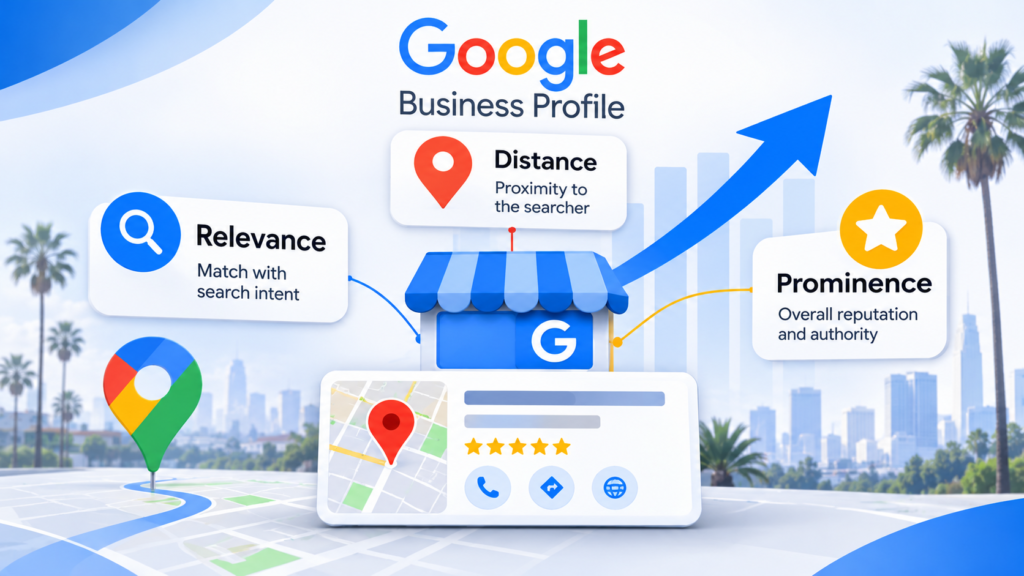
Google states that local results are mainly based on relevance, distance and prominence, and that there is no way to request or pay for better local placement.
Relevance is how closely your profile matches the query. You control it through category selection, your listed services, and the page your profile points to.
Distance is how far you sit from the searcher. In Orange County this is the cruelest input, because a competitor six blocks closer can outrank you on geometry alone.
Prominence is how well known the business is. Google names links from other sites plus review count and rating as contributing inputs.
The practical ordering: relevance gets you considered, distance decides who sees you, and prominence breaks the tie among everyone who clears the first two.
This matters for strategy because the two systems respond to different work. Profile work moves the map pack. Page work moves the organic results. You need both, and the sequence should usually be profile first, since it is faster and cheaper.
| Map pack | Organic results | |
| What ranks | Your Business Profile | Individual web pages |
| Dominant factors | Category, proximity, reviews, hours | Service pages, content relevance, links |
| Where effort goes | Google Business Profile | Your website |
| Typical movement | Weeks for profile fixes | Three to six months |
| Can you cover many cities? | Limited by profile rules | Yes, with dedicated pages |
What Google Business Profile optimization actually moves in 2026
Google Business Profile optimization is the work of making your free Google listing match what local searchers are actually typing, and it is the highest-return task available to most businesses because it costs nothing but attention.
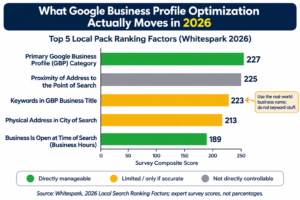
The data here is worth reading closely. Whitespark’s 2026 Local Search Ranking Factors report, published November 6, 2025, asked 47 local search practitioners to score 187 factors.
| Rank | Local pack factor | Score | Can you change it? |
| 1 | Primary Google Business Profile category | 227 | Yes, in minutes |
| 2 | Proximity of address to the searcher | 225 | No, short of moving |
| 3 | Keywords in the profile business title | 223 | Only if they are your real name |
| 4 | Physical address in the city of search | 213 | No, short of moving |
| 5 | Business is open at the time of search | 189 | Yes, through accurate hours |
Three findings from that report change what an Orange County or Riverside operator should do first.
Primary category outranks everything. It scored above proximity, and it is the one top-five factor you can correct this afternoon. We find mis-set primary categories on a surprising share of the profiles we audit.
Being open is now a top-five factor. Your listing can hold position one during business hours and slide once you close. For an Anaheim restaurant or a Moreno Valley emergency electrician, posted hours are a ranking decision, not an admin chore.
Review recency climbed to eleventh. A profile with 200 reviews and nothing new in eight months is weaker than a profile with 60 arriving steadily. Velocity beats stockpile.
One honest caveat about this data: it is expert opinion, not leaked algorithm documentation, and the report says so itself. Treat the ordering as a strong prior and verify it against your own grid tracking.
Two things worth knowing that most checklists skip. Google’s own guidance warns against stuffing keywords into your business name, and the same survey scored keyword stuffing the profile description as a suspension risk. Meanwhile “length of title tag” landed near the very bottom of the factor list, which is a useful reminder that some long-repeated advice has simply expired.
We cover the profile-level mechanics step by step in our guide to Google Business Profile optimization for California businesses, so this article stays on the two-county geography problem.
What local SEO for Orange County businesses should look like city by city
Local SEO for Orange County businesses works best when it stops pretending the county is one market and starts treating it as a handful of them.
Pick the three to five cities where you already close business. Expanding into an area you have never served produces a thin page, and the Google spam policies name city-targeted pages built mainly to manipulate rankings as doorway pages.
Four OC clusters cover most of the demand we see, and each rewards a different angle.
North County: Anaheim, Fullerton and Buena Park
High volume, mixed residential and commercial, and a visitor economy around the resort district that produces searchers with no local knowledge and no preferred provider.
Hospitality, home services and auto dominate. Posted hours matter unusually here, because a lot of this demand is same-day. Businesses starting in this cluster should anchor to our Anaheim SEO work.
Central: Santa Ana, Orange and Garden Grove
The county seat and the densest competitive overlap in the region. Proximity does most of the ranking work, so content volume rarely rescues a business sitting outside the core.
This is also the most linguistically mixed part of the county, and English-only pages concede real demand. Santa Ana SEO is where that work usually starts.
Irvine and the tech corridor
Higher consideration cycles, B2B and professional services, and a searcher base that compares three providers before calling anyone.
Prominence carries more weight here than anywhere else in the county. Do not start here without review volume. Our Irvine SEO page covers how we structure these campaigns.
South County and the coast: Newport Beach to San Clemente
High transaction values, lower population density, and a strong preference for businesses that read as genuinely local rather than as a north-county firm with a service radius.
Real community sponsorships and reviews that name the city carry unusual weight.
Our recommendation for most Orange County operators is unglamorous. Fix the profile in month one. Build one genuinely local city page in months two to four. Add the second city only once the first page is producing leads on its own.
How local SEO in Riverside works across 7,208 square miles
Local SEO in Riverside has to solve a coverage problem before it solves a competition problem, and that reverses the usual order of operations.
The county is roughly rectangular and very long. Riverside city to Blythe is about 173 road miles, which runs close to three hours of driving. Those are two different economies that happen to share a county government.
Riverside County breaks into three practical search regions:
- Western Riverside: Riverside, Corona, Moreno Valley, Jurupa Valley, Norco. Dense by county standards, strong overlap with San Bernardino demand, and the most competitive part of the county.
- Southwest: Temecula, Murrieta, Menifee, Wildomar, Lake Elsinore. Fast-growing, with real spillover from San Diego County buyers and a different competitive set entirely.
- Coachella Valley and the desert: Palm Springs, Palm Desert, Indio, La Quinta, Cathedral City. Seasonal demand, a tourism and hospitality skew, and a winter peak that inverts the normal calendar.
A business in Corona and a business in Indio are not competitors. Treating them as one campaign is the single most expensive assumption in inland local search.
Seasonality deserves a mention that most guides skip. Coachella Valley demand peaks when the rest of Southern California is quiet, which means profile and content work for that market needs to be live by early autumn, not in January when the season has already started.
Riverside local SEO guide: the checklist for inland operators
This Riverside local SEO guide assumes the thing OC guides can ignore, which is that distance is working against you rather than for you.
- Name your real sub-region first. Western Riverside, Southwest, or the desert. Not “Riverside County.”
- Check your service area against the driving-time rule before you set anything else. Most inland overreach starts here.
- Set your primary category to the single best match. It outscored proximity in the 2026 survey and takes minutes.
- Use a local area code. Inland searchers notice a 951 or 760 number, and it reinforces that you are genuinely in-market.
- Build one city page per city you actually serve, with real local detail rather than a swapped city name.
- Earn citations from inland sources: chambers in Corona, Temecula or Palm Desert, local business journals, community organizations.
- Run reviews as a monthly system, not a quarterly push. Recency is doing more work than it used to.
- Track by city, not by county, or you will never see which region pays for itself.
Businesses working here should start from our Riverside SEO services page, which covers scoping by sub-region rather than by county line.
Service-area business SEO: ranking without a storefront
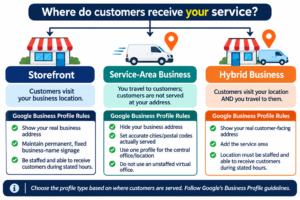
A service-area business is one that travels to customers instead of serving them at its own address, such as a mobile locksmith, a plumber or a pool service. Service-area business SEO is the version of this work you run when there is no storefront for Google to pin.
Google’s rules here are specific and widely broken, so they are worth stating exactly.
A service-area business gets one profile for the whole area it serves.
If you do not serve customers at your business address, that address comes off the profile entirely.
You can set up to 20 service areas, defined by city or postal code. Google says the overall boundary should not extend more than about two hours of driving time from your base, and the radius setting no longer exists.
A hybrid business is different. If you serve customers at your address and also travel to them, you show the address, set staffed hours, and add a service area on top. If your location has no permanent signage, it does not qualify as a storefront.
That two-hour guidance is the line most Riverside businesses cross without noticing. A Corona-based service business can legitimately reach Temecula and most of Western Riverside. It cannot legitimately claim Blythe.
The risk is not theoretical. In the 2026 survey, setting service areas larger than two hours of driving distance and showing an address when you are a service-area business both appeared on the suspension-risk list.
Here is the part that frustrates owners, and it is worth saying plainly: you cannot open separate profiles for Anaheim, Irvine and Santa Ana just because you drive to all three. One business, one territory, one profile.
What you can do instead is build the coverage on your own website. Dedicated page for each service scored as the top local organic factor in that same survey, and geographic keyword relevance of content came second. Your site is the mechanism for multi-city reach. Your profile is not.
Multi-location local SEO: one profile per real location
Multi-location local SEO applies when you have genuinely separate, staffed locations, and it is the one case where additional profiles are both allowed and necessary.
Google’s position is that there should be one profile per business location, and that you should not create more than one page for a location in any account. For service businesses, Google allows one profile per location when each has separate service areas and separate staff.
The word doing the work in that sentence is “separate.” A second profile needs a real address, real staff and its own service territory. A relative’s house in Temecula is not a second location.
Four rules carry most of the weight once you pass two locations:
- One primary category across locations that do the same thing. Vary categories only when a branch genuinely offers different core services.
- Do not overlap service areas across your own profiles. Overlapping service areas on multiple-location profiles showed up as a suspension-risk factor in the 2026 data, and you are competing against yourself anyway.
- Point each profile at its own location page, never the homepage. The page your profile links to is what Google reads for relevance.
- Give each location its own tracked phone number. Share one number across branches and you lose the ability to tell which location produced which call.
The duplicate-content trap is where most multi-location sites quietly fail. Five location pages built by swapping the city name are five thin pages, not five local assets. Each needs genuine local substance: the actual team, real projects, area-specific service details, local reviews.
If you operate in both counties, a Tustin location and a Murrieta location are separate campaigns with separate competitor sets. Budget them that way.
Local SEO lead tracking: calls, forms and enquiries
Local SEO lead tracking is the practice of connecting a search to an actual enquiry, and skipping it is why so many owners cannot say whether local search works for them.
The gap is phone calls. Most local service businesses take the majority of their enquiries by phone, and a default analytics setup records none of them. You end up reporting twenty form fills while a hundred calls go uncounted.
Set up four streams, in this order:
- Google Business Profile performance data. Calls, direction requests, website clicks and the search terms that triggered them. This is your map pack read, and it is free.
- A tracked number on the website with dynamic number insertion. Swapping the displayed number by traffic source is what lets you separate organic calls from paid ones. Use a consistent number on the profile itself.
- Form submissions as defined conversion events, with the source captured and passed through to wherever you manage leads.
- Outcome data from your CRM or job system. Which enquiries became quoted work, and which became revenue.
Two measurement habits matter more than the tooling.
Set a minimum call duration before counting a lead. A ten-second call is a wrong number. Most operators we work with use 60 to 90 seconds as the threshold, which quietly removes a lot of flattering noise from the report.
Segment every metric by city. County-level reporting is where multi-city campaigns go to die. If Corona pays for itself and Indio does not, you need to see that in month four, not month twelve.
One caveat worth stating: local SEO attribution is never perfectly clean. Someone sees you in the map pack on a phone, searches your name on a laptop two days later, then calls. That journey will show as branded search, not local. Judge the channel on trend and total enquiry volume rather than on last-click purity.
The local SEO checklist for Orange County and Riverside
Use this local SEO checklist as a sequence rather than a menu. The order reflects return on effort, not importance in the abstract.
Profile foundations (week one)
- Claim and verify the Business Profile
- Set the single most accurate primary category, then add relevant secondary categories
- Confirm your business name matches real-world signage with no added keywords
- Enter accurate hours, including seasonal and holiday hours
- Decide storefront, service-area or hybrid, and set the address accordingly
- Check the map pin sits on the actual entrance
- Add the predefined services Google suggests for your category
Coverage decisions (week two)
- List the cities where you already have customers
- Check your service area against the two-hour driving-time guidance
- Decide which three to five cities get their own page
- Confirm each additional location is genuinely staffed before creating a profile
Website layer (months one to four)
- One dedicated page per service
- One city page per target city, with real local substance
- NAP in the site HTML matching the profile exactly
- Profile landing page pointed at the relevant city or location page
- Mobile load speed and tap-to-call checked on an actual phone
Ongoing (every month)
- Request reviews steadily rather than in bursts
- Respond to every review
- Add fresh, real photos
- Audit citations for NAP drift after any move or rebrand
- Review calls, forms and enquiries by city
Our 47-point audit checklist walks through the technical layer with free tools if you want to run the first pass in-house.
When it makes sense to hire help
Most of this is doable without an agency. A single-location business serving two or three cities can run its own profile, request reviews and publish decent city pages.
Bringing in help makes sense at a specific threshold: more than four cities, more than one location, more than one language, or a category where competitors have a multi-year head start. Anyone worth hiring will tell you when you are below that line.
What a California-specific partner adds is narrower than most marketing claims. City-level keyword data rather than metro estimates. Citation and link relationships with chambers and local publications that cannot be bought quickly. Geo-segmented reporting that shows which cities produce revenue.
If you are comparing providers, our guide to choosing an SEO company in California lists the twelve questions worth asking before you sign anything. Our local SEO services page covers how we scope this work.
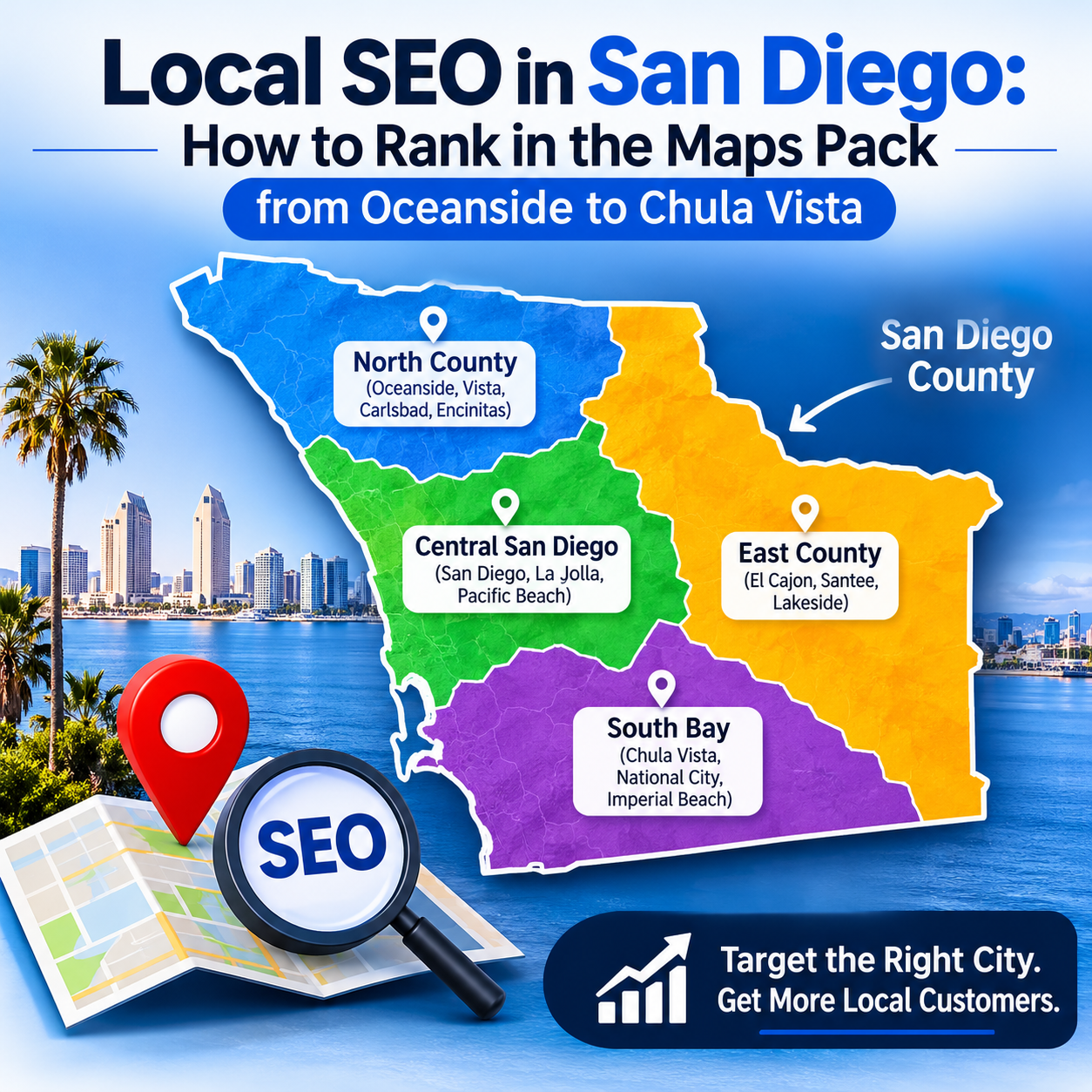
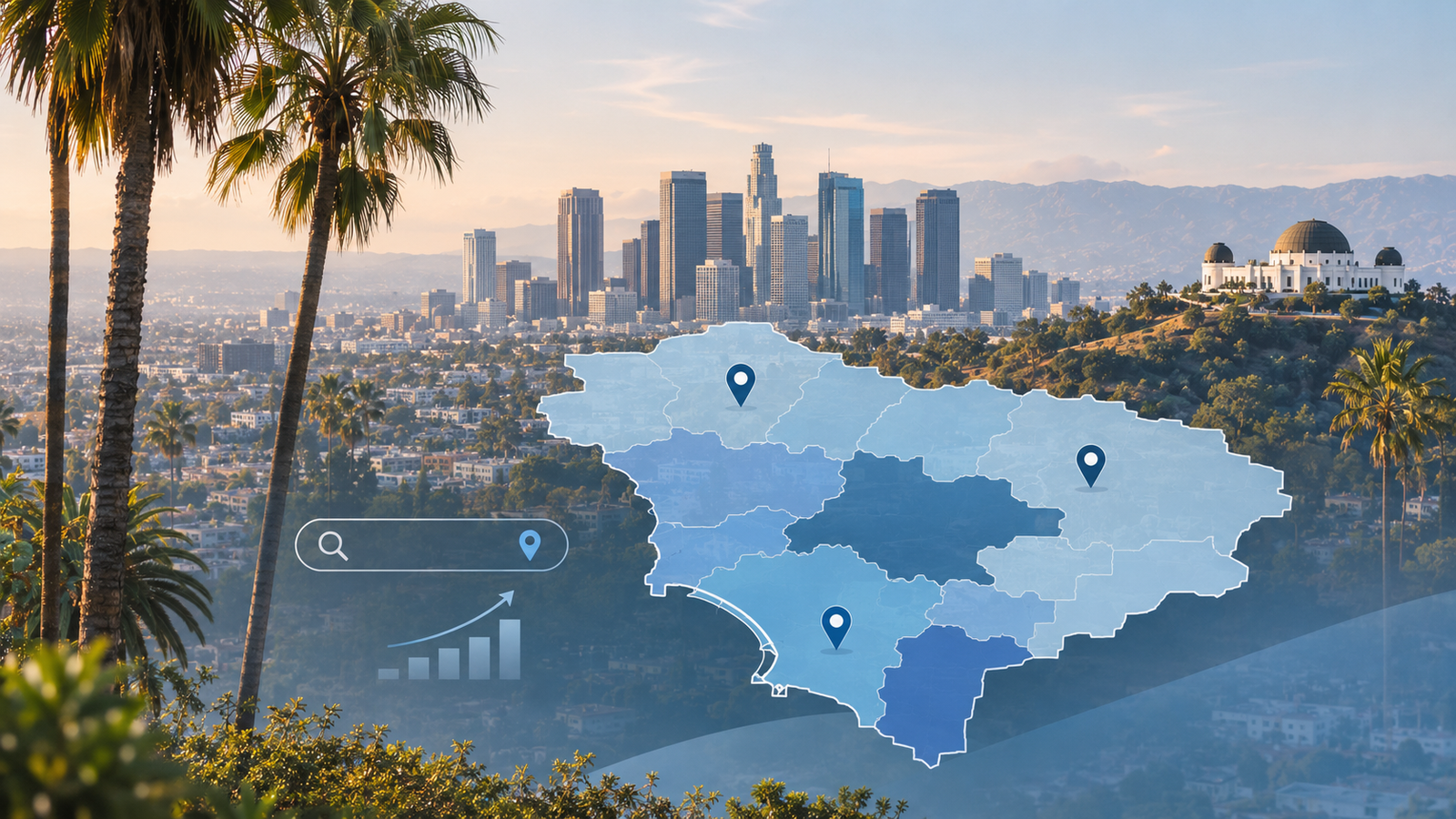
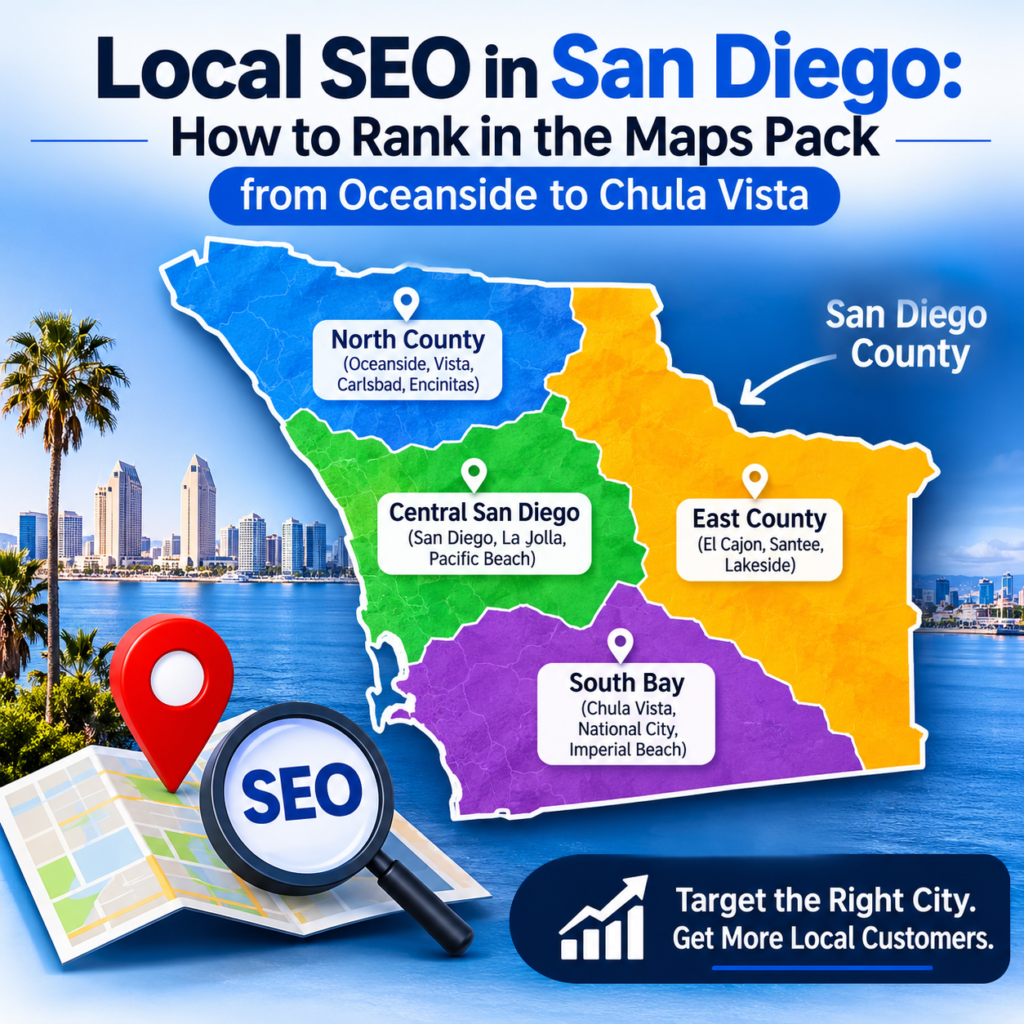
Businesses operating across several California metros may also want the Los Angeles breakdown and the San Diego guide, since each county fragments on different lines.
Frequently asked questions
Should you target Orange County or a specific city?
Target specific cities first for almost every business. A county-wide page competes against every established brand in a three-million-person market, while a city page competes against a handful of local operators. Build three to five pages for cities where you already have customers, then let the county page absorb the authority those pages generate.
How long does local SEO take in Orange County and Riverside?
Profile corrections such as category, hours and photos can show movement within a few weeks. Competitive city rankings typically take three to six months. Dense Orange County categories like Irvine professional services take longer than most of inland Riverside, because the competitive set is deeper rather than because the tactics differ.
Can one business rank in both Anaheim and Temecula?
Rarely in the map pack, because those cities sit roughly 60 miles apart and proximity is a top-two ranking factor. You can rank organically in both with dedicated city pages. For map pack placement in both, you generally need a staffed location in each, which is a business decision rather than an SEO one.
How many service areas can a Google Business Profile have?
Up to 20, set by city or postal code rather than by radius. Google also says the overall boundary should not extend more than about two hours of driving time from your base.
That limit is easy to respect in Orange County and easy to breach in Riverside County, where the drive from the western cities to Blythe runs close to three hours.
What is the single most important Google Maps ranking factor?
In the 2026 expert survey, the primary Google Business Profile category scored highest for the local pack, just ahead of proximity to the searcher. Category is the rare top-ranked factor you can correct in minutes, which makes it the first thing to check on any underperforming profile.
Do you need a separate page for every city you serve?
For organic visibility, yes, provided each page has genuine local substance. Pages built by swapping a city name into otherwise identical copy risk being treated as doorway pages under the Google spam policies. A city page will not place you in that city’s map pack on its own, but it does capture organic demand you would otherwise miss.
Why are Google Business Profile calls missing from your website analytics?
Because profile calls happen before anyone reaches your website, so standard site analytics never sees them. You read those in the Business Profile performance report. To capture website calls separately, use a tracked number with dynamic number insertion, then set a minimum call duration so wrong numbers do not inflate your lead count.
Is local SEO still worth it with AI search answering more queries?
For local intent, yes. Local discovery still runs predominantly through Google’s local results, and the 2026 survey found that citations and mentions across directories and review sites are now among the strongest signals for AI visibility too. The practical implication is that the same foundational work serves both surfaces.
Ready to see where your business actually ranks across both counties?
Our free 47-point audit shows your current map pack position city by city, delivered in 12 hours with no commitment. Get your free SEO audit.